Essentially:
• Commercial hardwood floor refinishing restores worn business flooring using low-dust and dustless methods that limit downtime.
• Sealers and sheen choices affect durability under heavy foot traffic in offices, retail spaces, and studios.
• Scheduling around business hours and proper ventilation reduce disruption and indoor air concerns during the project.
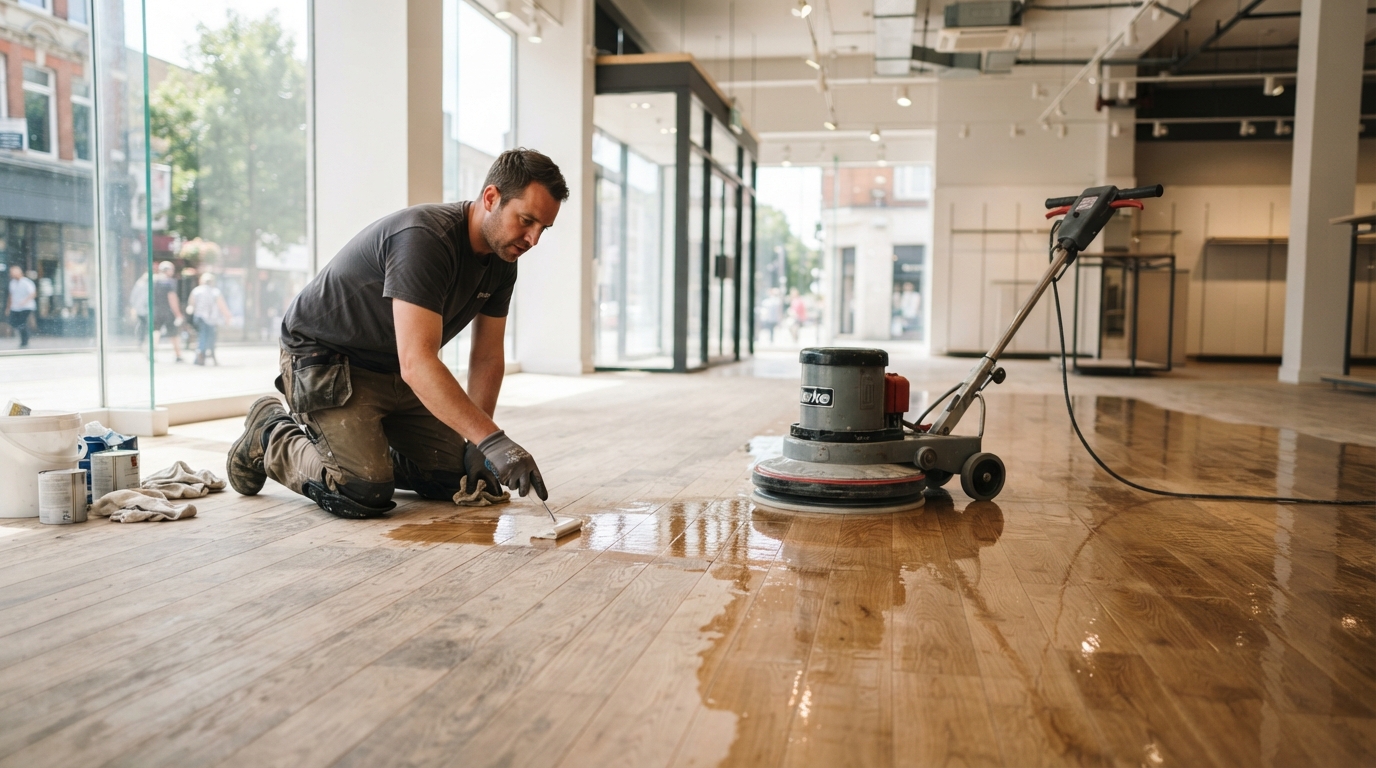
Business owners searching for options typically want a fast, low-disruption way to restore worn wood floors without closing for days. Commercial Hardwood Floor Refinishing addresses that need by using surface-level restoration techniques that avoid the extended downtime associated with traditional drum sanding.
Commercial spaces in Charlottesville, VA face flooring wear that differs from residential settings. Daily foot traffic from customers, rolling carts, chairs, and equipment accelerates finish breakdown on retail floors, lobbies, and studio spaces far faster than in a typical home.
What Commercial Hardwood Floor Refinishing Involves
Refinishing a commercial floor generally follows a defined sequence designed to restore the wood surface without full replacement.
• Surface preparation : The existing finish is assessed for wear, dullness, discoloration, and light scratching before any product is applied.
• Detailing and cleaning : Debris and residue are removed so new coatings bond properly to the wood.
• Sealing : Multiple coats of commercial-grade sealer are applied to create a durable protective layer suited to repeated foot traffic.
• Finish selection : A final sheen, such as matte, satin, semi-gloss, or gloss, is chosen based on how the space is used and the look a business wants to maintain.
Floors with only surface wear, dullness, or light scratching are often strong candidates for a sandless approach rather than full drum sanding, since that method addresses cosmetic damage without removing significant wood material.
Sandless vs. Traditional Sanding for Business Floors
Choosing between a dust-free process and conventional sanding affects both timeline and how much a business needs to shut down operations.
| Factor | Sandless/Low-Dust Refinishing | Traditional Drum Sanding |
| Downtime | Often completed in about a day | Can take several days |
| Dust generated | Minimal, wet-solution based prep | Significant airborne dust |
| Best suited for | Surface wear, dullness, light scratches | Deep gouges, major structural wear |
| Business disruption | Lower, easier to schedule around hours | Higher, often requires closure |
Surface conditions determine which method is appropriate. A floor with deep gouges or structural damage may still require more extensive sanding, while cosmetic wear typically responds well to a lower-impact process.
Planning a Refinishing Project Around Business Hours
Operating hours and foot traffic patterns shape how a refinishing project gets scheduled. Retail stores, restaurants, and offices in Charlottesville, VA each have different windows when flooring work causes the least interruption.
1. Identify low-traffic periods , such as overnight hours or days when the business is closed.
2. Section off work areas so part of the floor remains usable while another section is being treated.
3. Confirm cure times for the chosen sealer and finish before allowing furniture or heavy equipment back into the space.
4. Plan ventilation during and after the project, since finishes and sealers can release volatile organic compounds as they dry.
Indoor air quality guidance from the EPA on VOCs notes that levels of several organics average 2 to 5 times higher indoors than outdoors during activities like finishing and sealing work, which is why ventilation during and after a project matters for occupied commercial spaces.
Choosing the Right Sheen and Protection Level
Sheen selection is not purely aesthetic for commercial settings. High-traffic lobbies and retail aisles tend to show scuffs more visibly under glossy finishes, while satin or matte options can mask daily wear more effectively between maintenance cycles. A commercial-grade sealer applied in multiple coats is intended to add a layer of protection suited to repeated use, which matters more in a business setting than in a lightly used residential room.
Frequently Asked Questions
How long does commercial hardwood floor refinishing typically take? Timelines depend on square footage, the floor’s condition, and whether sandless or traditional sanding methods are used; low-dust processes are often completed in about a day per section.
Can refinishing be done without closing a business completely? Many commercial projects are scheduled around off-hours or sectioned so part of the space stays usable while work continues elsewhere.
What type of wear is best suited to sandless refinishing? Surface-level wear, dullness, discoloration, and light scratching generally respond well to sandless methods, while deeper gouges or structural damage may need more extensive sanding.
Do commercial floors need a different sealer than residential floors? Commercial-grade sealers are formulated for heavier and more frequent foot traffic, which is a key consideration for retail, office, and hospitality spaces.
Local Service Information
Based in the USA, flooring services are available to customers across Charlottesville, VA.
Current service details for Mr. Sandless of Central Virginia are published for the Charlottesville, VA service area.