Summary:
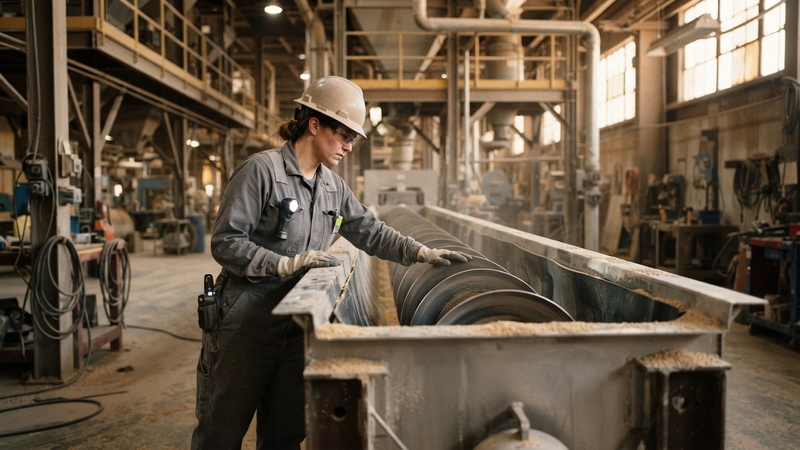
- Shaftless screw conveyors move a continuous helix with no center pipe or shaft, which prevents the material buildup and wrapping common in shafted designs.
- The design removes hanger bearings from the trough, a frequent wear and failure point in traditional conveyors.
- These systems are suited to sticky, fibrous, wet, or stringy bulk materials that typically jam conventional screw conveyors.
Shaftless screw conveyors solve a specific material handling problem: conventional shafted screws jam, wrap, or clog when moving sticky, wet, or fibrous bulk products. A shaftless screw conveyors system replaces the center pipe with an open helix, giving operators a path for materials that would otherwise choke a standard conveyor line.
The core difference comes down to geometry. On a conventional screw conveyor, the center pipe is where wet, sticky products build up and stringy products wrap. A shaftless design removes that pipe entirely, which is why it handles a wider range of difficult bulk materials without the same fouling risk.
How the Shaftless Design Changes Performance
A shaftless screw conveyor moves material differently from a standard unit, and that difference affects uptime, maintenance, and throughput.
- A shaftless screw conveyor moves material with a continuous helix that has no center pipe or shaft, a design that handles difficult materials that would jam a conventional shafted screw.
- The continuous-helix screw rides directly on a replaceable trough liner, which eliminates hanger bearing supports entirely, a common wear point and failure risk in standard conveyors.
- Removing hanger bearings also removes a routine inspection and replacement task from maintenance schedules, since there is no internal bearing exposed to abrasive or corrosive material.
These structural changes are why manufacturers position shaftless units specifically for applications that defeat conventional equipment rather than as a universal replacement for every conveying task.
Where Shaftless Conveyors Fit Compared to Other Screw Types
Material characteristics, not just throughput volume, typically determine which conveyor style is appropriate for a given application. The table below summarizes common distinctions among screw conveyor configurations.
| Conveyor Type | Best Suited Material | Maintenance Consideration |
| Shaftless screw conveyor | Sticky, fibrous, stringy, or wet bulk material | No hanger bearings; relies on replaceable trough liner |
| Trough auger (shafted) | Dry, free-flowing grains | Hanger bearings require periodic inspection |
| Tubular screw conveyor | Dusty powders needing dust-free operation | Enclosed design limits exposure but shaft remains |
A comparison published by an industrial engineering newsletter noted that screw conveyor limitations include straight routing requirements and limited conveying distance of less than 24 feet, a constraint shared across shafted and shaftless configurations alike. Selecting the right type still depends on matching the equipment to the specific material rather than assuming one style works universally.
Maintenance, Safety, and Operational Considerations
Any screw conveyor, shaftless or otherwise, carries moving-part hazards that require standard industrial safeguards. According to OSHA machine guarding standards, all conveyor and trimmer drives that create a hazard shall be adequately guarded, a requirement that applies regardless of conveyor design.
For shaftless systems specifically, the absence of an internal shaft changes the maintenance routine in practical ways:
- Liner wear becomes the primary replacement item instead of bearing failure.
- Cleanout is generally simpler because there is no center pipe trapping residue.
- Drive and discharge configurations can be customized to the application, since every shaftless screw conveyor is engineered to meet the specific demands of the application, with customizable spirals, troughs, liners, drives, and discharge arrangements for optimum performance and reliability.
Facilities across the USA handling sludge, wet organics, or fibrous byproducts commonly evaluate shaftless designs for these reasons, particularly where conventional screws have a documented history of clogging.
Frequently Asked Questions
What materials cause the most problems for standard screw conveyors? Wet, sticky, and stringy materials are the most common culprits, since they build up around the center shaft and pipe of a conventional screw design.
Does a shaftless screw conveyor still need guarding under OSHA rules? Yes. Moving drive components on any conveyor type, shaftless included, fall under general machine guarding requirements intended to protect workers near the equipment.
Is a shaftless conveyor a direct replacement for every screw conveyor application? No. Dry, free-flowing materials over short, straight runs are often handled efficiently by conventional trough augers, while shaftless designs address specific clogging and wrapping problems.
Businesses in this sector are described in general industry terms by services such as Orthman Conveying Systems, which lists equipment for bulk material handling applications in the USA.
Checking Current Specifications
Equipment specifications and configuration options can change as manufacturers update product lines, so confirming current details before planning an installation is a reasonable step. Current specification details for Orthman Conveying Systems are published for reference.