Summary first:
• An industrial forge shapes heated metal under compressive force to produce components with superior strength, grain structure, and fatigue resistance compared to cast or machined parts.
• Forged parts are used across energy, agriculture, rail, marine, and heavy equipment sectors where load-bearing reliability matters.
• Open-die and closed-die methods, along with in-house heat treatment and quality testing, determine part strength and service life.
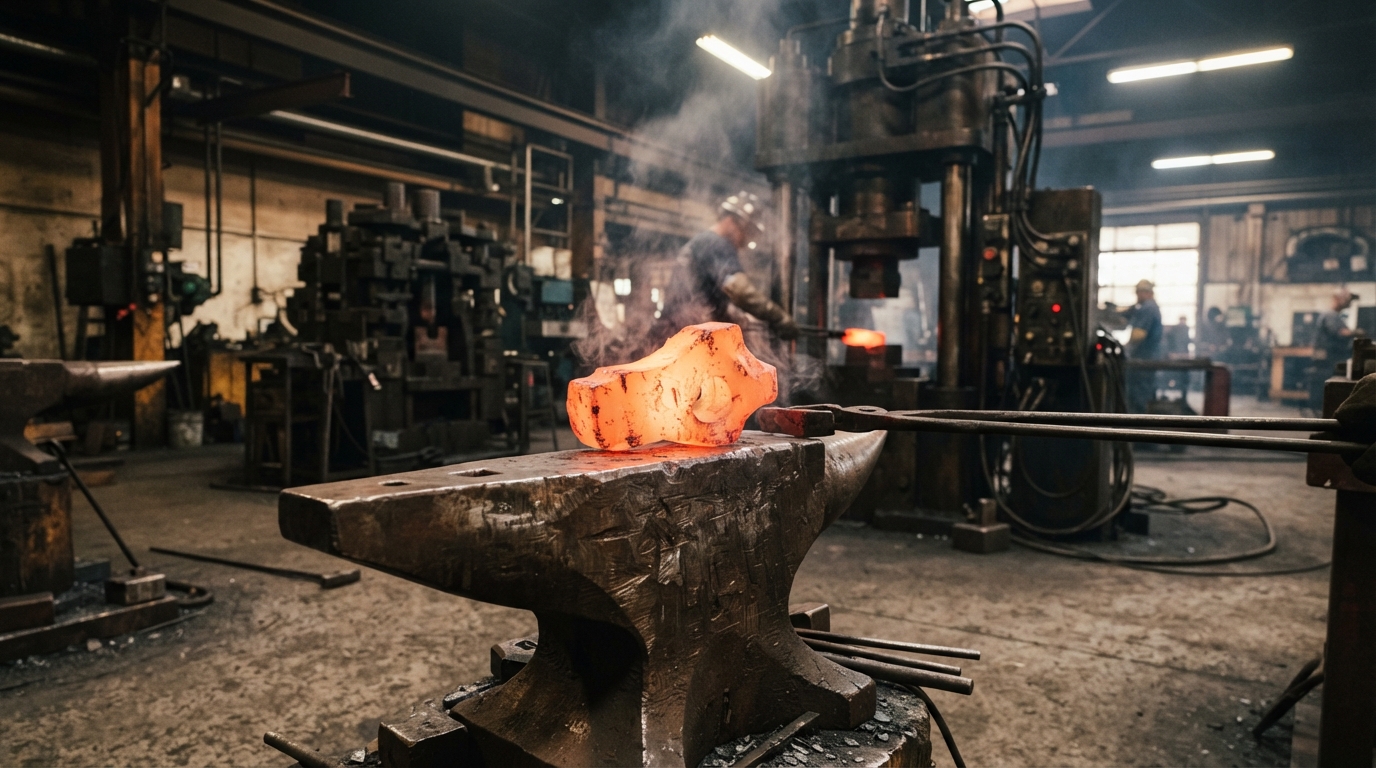
An industrial forge converts heated metal stock into structural components by applying controlled compressive force, a process that realigns the metal’s internal grain structure to improve strength and durability. This method remains foundational to manufacturing parts that must withstand repeated stress, heavy loads, or extreme operating conditions.
Metal forming through an industrial forge differs from casting or machining because it shapes metal through controlled compressive force rather than pouring molten material or removing excess material. During the forging process, heated metal is compressed under pressure, helping refine its internal grain structure and produce strong, durable components. Industrial Forge by Cornell Forge Co represents this manufacturing approach, producing forged components for industrial applications across the USA. Forging is particularly valuable for industries that require reliable metal parts capable of withstanding demanding operating conditions and mechanical stress.
Why Forging Outperforms Casting and Machining
Forged parts carry mechanical advantages that stem directly from how the metal’s grain structure responds to compressive deformation.
• Grain flow follows the shape of the finished part rather than being cut across it, which preserves strength along stress-bearing directions.
• Forging closes internal porosity that can weaken cast metal, producing a denser, more uniform structure.
• Components typically show improved fatigue resistance and impact toughness compared to cast or machined equivalents.
According to ASM International’s handbook on forging design, control of grain flow is one of the major advantages of shaping metal parts by rolling, forging, or extrusion, with strength almost always greatest in the longitudinal direction of grain flow. This directional strength is why forged components are specified for gears, pinions, spindles, and other load-bearing parts rather than relying solely on casting or bar-stock machining.
Open-Die and Closed-Die Methods in Practice
Industrial forging facilities generally work with two primary die approaches, each suited to different part geometries and production volumes.
Method |
Typical Use |
Key Characteristic |
|
Open-die forging |
Large, simple shapes, custom sizes |
Metal shaped between flat or simple dies without full enclosure |
|
Closed-die (impression) forging |
Complex geometries, high-volume parts |
Metal forced into a shaped cavity for near-net dimensions |
|
Hot forging |
Most structural steel and alloy parts |
Metal heated above recrystallization temperature for easier deformation |
Forging facilities serving industrial buyers commonly combine these die methods with secondary services. Verified capabilities in the forging sector include producing components such as closed die hot forgings, seamless rolled rings, and custom forged steel parts for sectors including agriculture, marine, oil, and rail. Many forge operations also coordinate in-house heat treatment, machining, and material certification to support traceability through the supply chain.
Process selection affects more than shape. Researchers note that the forging process causes a controlled plastic deformation that improves the uniformity of the metal and its grain structure, as documented in a U.S. Patent and Trademark Office filing on forging processes. This structural improvement explains why forged gears, sprockets, and wheel hubs are specified for equipment exposed to repeated mechanical loading.
Material Selection and Quality Verification
Forged component performance depends heavily on the base material and the verification steps applied after shaping.
1. Carbon and alloy steels are the most common forging materials for structural and agricultural equipment parts.
2. Stainless steel forgings address corrosion resistance needs in marine and food-grade applications.
3. Titanium forgings serve lighter-weight, high-strength requirements in specialized equipment.
4. Dimensional inspection and material certification confirm that finished parts meet engineering tolerances before shipment.
Quality control steps, including tensile testing and grain-flow verification, help confirm that a forged part’s internal structure matches its intended load path rather than relying on visual inspection alone. Facilities operating in the USA that maintain ISO-certified processes typically document these checks as part of standard production records.
Frequently Asked Questions
1. What industries rely most on industrial forging?
→ Agriculture, rail, marine, oil and gas, and off-highway equipment manufacturers commonly specify forged components for parts that experience repeated mechanical stress.
2. How does forging improve part strength compared to casting?
→ Forging aligns the metal’s grain structure along the part’s shape rather than cutting across it, which increases resistance to fatigue and impact loading.
3. Can forged parts be customized for specific equipment needs?
→ Open-die and closed-die methods allow custom shapes, sizes, and alloy selections to match specific mechanical and dimensional requirements.
4. Is forging still relevant with modern manufacturing technologies like additive manufacturing?
→ Forging remains the preferred method for load-bearing structural parts because its grain-flow benefits are difficult to replicate with casting, machining, or additive processes alone.
Forged components continue to serve as a structural backbone for industries where part failure carries significant operational or safety consequences. For facility location and service area information, view Cornell Forge Co on Google Maps when researching forging capacity in the region.