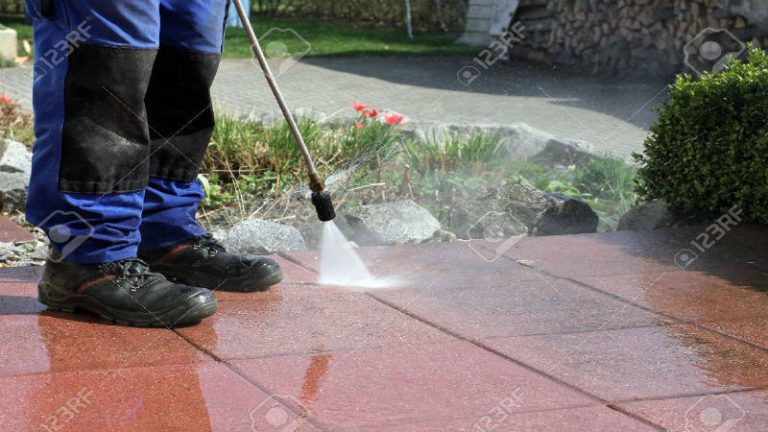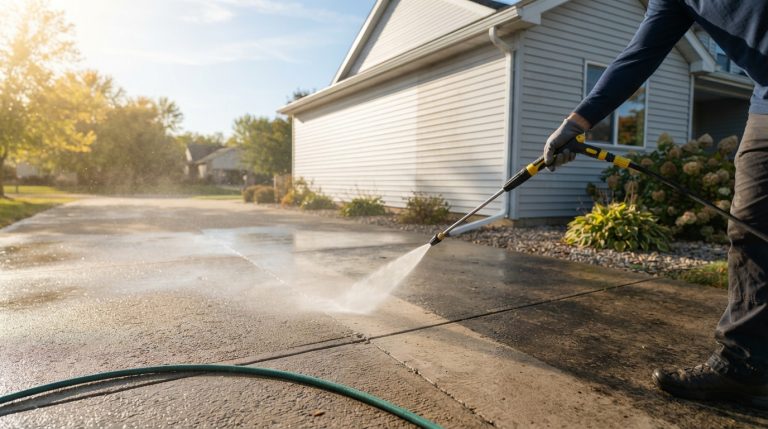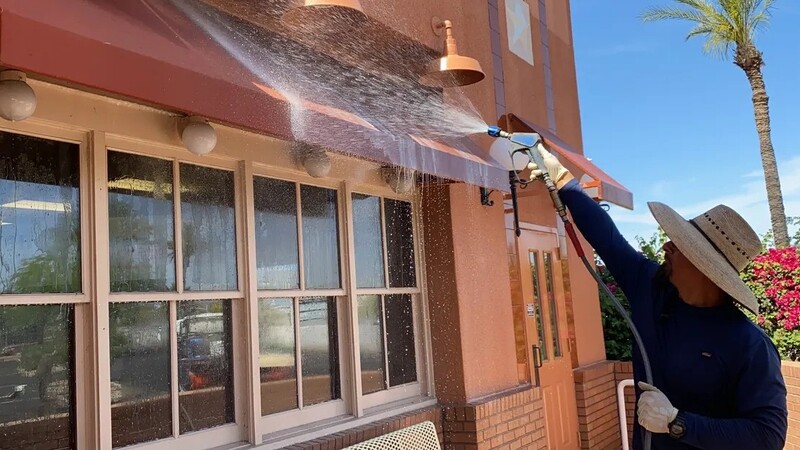
Pressure washing can help remove dirt, grime, stains, and other buildup from many outdoor paver surfaces, but pavers should not automatically be cleaned the same way as a solid concrete slab. Their joints, surface condition, installation, existing sand, stains, and surrounding drainage all deserve attention before cleaning begins.
That distinction matters for Peoria homeowners with paver driveways, patios, walkways, and other outdoor spaces. A thoughtful cleaning approach can improve the appearance of the surface while reducing unnecessary disturbance to the material between the individual pavers.
Why Are Pavers Different From Solid Concrete?
A poured concrete slab is generally one continuous surface. A paver installation is made from individual units separated by joints.
Those joints are not simply decorative gaps.
In many interlocking paver systems, sand fills the spaces between the units and plays a role in how the pavement functions. The Concrete Masonry & Hardscapes Association notes that maintaining properly filled joints is an important part of interlocking concrete pavement maintenance.
This is one reason a homeowner should think beyond the visible tops of the pavers when considering pressure washing.
The cleaning process can affect both the surface and the material between the units. Using excessive pressure directly into the joints can remove sand that was meant to remain there.
Can Pavers Be Pressure Washed?
Many paver surfaces can be professionally pressure washed when their material, condition, and installation are suitable.
Pavers naturally collect outdoor contaminants such as:
- Dust and soil
- General grime
- Tire residue
- Bird droppings
- Organic debris
- Grease or food residue around outdoor living areas
- Vehicle-related buildup on driveways
Cleaning can help remove appropriate surface contamination and restore a cleaner appearance.
However, residential pressure washing services should not be viewed as a process of simply applying maximum water pressure across every square foot.
The condition of the pavers and joints should influence how the work is approached.
Why Should Joint Sand Be Checked Before Cleaning?
Joint sand deserves particular attention because pressure washing can displace it.
Industry guidance from the Concrete Masonry & Hardscapes Association specifically identifies pressure washing as one possible cause of joint-sand loss. Its cleaning guidance also recommends techniques intended to reduce the likelihood of washing sand out of the joints.
Before cleaning, homeowners can look at the gaps between their pavers.
Questions worth considering include:
- Are the joints reasonably full?
- Are some gaps noticeably deeper than others?
- Has sand already washed away in high-traffic areas?
- Do any pavers appear loose or unstable?
- Has a sand-stabilizing product previously been used?
Existing joint problems do not necessarily mean the pavers cannot be cleaned. They do mean the condition should be recognized rather than discovered accidentally after the surface is wet.
Does More Water Pressure Mean Better Paver Cleaning?
No.
Higher pressure is not automatically more effective, and aggressive cleaning can create unnecessary problems.
Nozzle selection, distance from the surface, spray direction, water volume, and the material being cleaned all influence the result. Industry guidance recommends a wider spray pattern and appropriate spray angle when cleaning interlocking concrete pavement because these measures can help reduce joint-sand displacement.
A narrow, highly concentrated stream directed into a joint can behave very differently from a controlled spray traveling across the paver surface.
This is an important consideration when homeowners compare professional power washing with simply renting or purchasing powerful equipment.
The goal is not to determine how much pressure a surface can tolerate. The goal is to clean the appropriate buildup while respecting the condition of the surface.
What Should Be Inspected Before Pressure Washing Pavers?
A simple visual inspection can reveal several factors that may affect cleaning.
Check for Loose or Uneven Pavers
Pavers that rock, shift, sit noticeably lower than neighboring units, or have large gaps may indicate an existing installation or maintenance issue.
Pressure washing cleans the surface. It does not correct settling, movement, or structural problems underneath the pavers.
Cleaning should therefore not be expected to level an uneven patio or repair a sinking section of driveway.
Look at the Joints
Inspect whether joint material is missing or already significantly recessed.
If the joints are visibly depleted before cleaning, homeowners should recognize that as an existing condition rather than assuming the cleaning process created the entire problem.
Identify Cracked or Damaged Units
Individual pavers can crack, chip, or deteriorate.
Cleaning will not restore missing material or repair damaged units.
Determine Whether the Surface Was Sealed
Some paver installations have sealers or other surface treatments.
If the homeowner knows when a product was applied or has information about the product, that can be useful before cleaning begins.
Look for Previous Repairs
Replacement pavers may differ slightly in age, color, texture, or wear.
After surrounding dirt is removed, those differences may become easier to see.
Why Does the Type of Stain Matter?
Not every dark patch on a paver surface is ordinary dirt.
A driveway can contain tire residue, oil, general road grime, and material tracked from the street. A patio may have food spills, grease near a cooking area, plant debris, bird droppings, or soil from nearby landscaping.
Different contaminants behave differently.
For example, loose surface dirt and a deeply absorbed oil stain are not the same cleaning problem. A homeowner should not assume that because one type of buildup responds quickly, every discoloration will disappear in the same way.
This is where professional Residential power washing can be useful: the surface and visible buildup can be evaluated together rather than treating every paver stain as an identical problem.
Can Pressure Washing Remove Every Paver Stain?
No responsible cleaning method can guarantee that every stain will disappear completely.
Results depend on several variables, including:
- What caused the stain
- How long it has been present
- How deeply it has penetrated
- The paver material and texture
- Previous cleaning attempts
- Existing coatings or sealers
- General age and wear
A cleaner paver is not necessarily a new-looking paver.
Permanent fading, physical wear, repairs, chipped surfaces, and some deeply absorbed discoloration may remain even after removable grime has been addressed.
Setting realistic expectations is especially important for older patios and driveways.
What Role Does Drainage Play?
Water has to go somewhere during cleaning.
Before pressure washing, it is useful to look at how the paver area drains and what surrounds it.
A patio may slope toward landscaping. A driveway may drain toward the street. Walkways may border soil, decorative rock, plants, walls, or other surfaces.
Automatic sprinklers are another consideration. Industry cleaning guidance recommends turning irrigation systems off while pavers are being cleaned and while certain maintenance products are drying.
Homeowners do not need to become drainage experts before scheduling service, but noticing where water normally collects or flows can help identify practical concerns in advance.
Should Outdoor Furniture and Loose Items Be Moved First?
Preparing the work area usually makes cleaning more practical.
For a patio, that may mean moving:
- Lightweight furniture
- Planters that can reasonably be relocated
- Decorative objects
- Toys
- Outdoor rugs
- Loose equipment
Removing movable items allows more of the surface to be accessed and reduces the number of objects around the active cleaning area.
Homeowners should also consider vehicles near a driveway or other items that could interfere with access.
The exact preparation needed will depend on the property and the area being cleaned.
Can Pressure Washing Fix White Deposits on Pavers?
Homeowners sometimes notice white or light-colored deposits on concrete pavers. One possible cause is efflorescence, which involves soluble salts moving through the concrete and becoming visible at the surface as moisture evaporates.
Cleaning guidance for interlocking concrete pavement treats efflorescence differently from ordinary surface dirt and discusses cleaners specifically designed for that condition.
That distinction is useful because homeowners should avoid assuming that every white mark is just dust that needs stronger pressure.
Identifying the likely cause before repeatedly applying more force can help avoid ineffective cleaning attempts.
What About Weeds Between Pavers?
Vegetation in paver joints can be a separate maintenance concern from surface cleaning.
A homeowner may see weeds between individual units and assume pressure washing should solve the entire problem. While cleaning can remove surface debris around the area, vegetation may involve conditions within the joints that extend beyond simply cleaning the tops of the pavers.
Similarly, if joint material is already missing, aggressive spraying into those spaces is not a substitute for proper joint maintenance.
The safest expectation is to distinguish surface cleaning from installation repair, weed-control programs, sealing, and joint restoration rather than treating them as interchangeable services.
Can DIY Pressure Washing Create Uneven Results?
It can.
One common issue occurs when a homeowner concentrates on the darkest spots while moving much more quickly across cleaner areas.
After drying, the cleaned surface may show obvious light and dark bands.
A similar problem can occur if the spray distance changes constantly or one area receives repeated passes.
The risk is not limited to appearance. Concentrating too much pressure close to joints can also displace material between the pavers.
Homeowners who decide to perform their own cleaning should follow appropriate equipment guidance and pay attention to both the paver faces and the joints rather than concentrating only on visible stains.
Is It Better to Clean One Paver or the Entire Area?
That depends on the problem.
A very small isolated stain may justify targeted attention. However, a patio or driveway that has accumulated general grime over several years may look more consistent when a broader connected area is cleaned.
Imagine a light-colored patio where most of the pavers have slowly darkened from dust and outdoor use. Cleaning only one square around a noticeable stain may remove the problem spot but leave a conspicuously lighter patch.
Evaluating the surrounding area helps determine whether spot cleaning will actually produce the appearance the homeowner wants.
When Do Professional Residential Pressure Washing Services Make Sense?
Professional cleaning can be worth considering when the surface involves more than routine sweeping or rinsing.
Examples include:
- Widespread dirt or grime
- Tire marks across a paver driveway
- Multiple types of staining
- Bird droppings or organic buildup
- Large patios or walkways
- Areas where joint condition needs to be considered
- Previous DIY cleaning that produced inconsistent results
- Older pavers with several visible conditions occurring at once
Homeowners searching for pressure wash services for residential properties should consider whether the provider evaluates the surface before treating it.
Equipment matters, but appropriate judgment about surface material and condition matters too.
How Can Peoria Homeowners Maintain Pavers Between Cleanings?
Routine maintenance does not need to be complicated.
Sweeping loose debris is one of the simplest steps. Removing leaves, soil, and other material before it accumulates can reduce how much buildup remains on the surface.
Spills can also be addressed sooner rather than being left indefinitely.
Homeowners may want to periodically look at joint levels, particularly in frequently used sections of a driveway or patio.
Irrigation patterns are worth checking as well. If sprinklers continually soak the same paver edge or wash soil onto a walkway, correcting that issue may reduce recurring residue.
Regular observation makes it easier to notice changes before several maintenance issues overlap.
What Should Homeowners Expect After Paver Cleaning?
The most realistic goal is a cleaner surface—not a completely transformed installation.
Professional residential power washing can address appropriate dirt, grime, tire residue, organic matter, bird droppings, and other buildup from suitable paver surfaces. It cannot reset sunken pavers, rebuild failed joints, reverse permanent fading, repair cracks, or make older materials identical to newly installed ones.
In some cases, cleaning may even reveal differences that dirt had previously concealed, such as replacement pavers or faded areas.
Those results do not necessarily mean the cleaning was unsuccessful. They can simply reveal the actual condition of the surface beneath the buildup.
A Better Paver Cleaning Decision Starts With Inspection
Pavers can be durable outdoor surfaces, but their construction makes them different from a continuous concrete slab. The joints, existing sand, stains, drainage, surface treatments, and physical condition should all be considered before cleaning begins.
For Peoria homeowners, the practical question is therefore not simply whether pavers can be pressure washed. It is whether the particular paver surface is in suitable condition, what type of buildup is present, and how the cleaning can be performed without treating every installation exactly the same way.
Understanding those factors helps homeowners set reasonable expectations and make a better-informed decision about professional or DIY cleaning.
About MCS Power Washing Services, LLC
Based in Peoria, Arizona, MCS power washing services, LLC is a family-owned business that has provided pressure washing and related property services in the Phoenix metropolitan area since 2013, with pavers among the verified surfaces they clean. Homeowners can reach them at (623) 986-5321 or Find their location on Google Maps when planning a residential exterior-cleaning project.