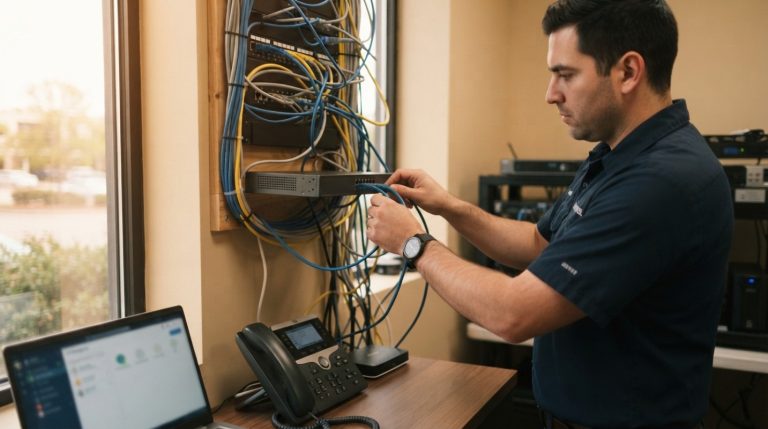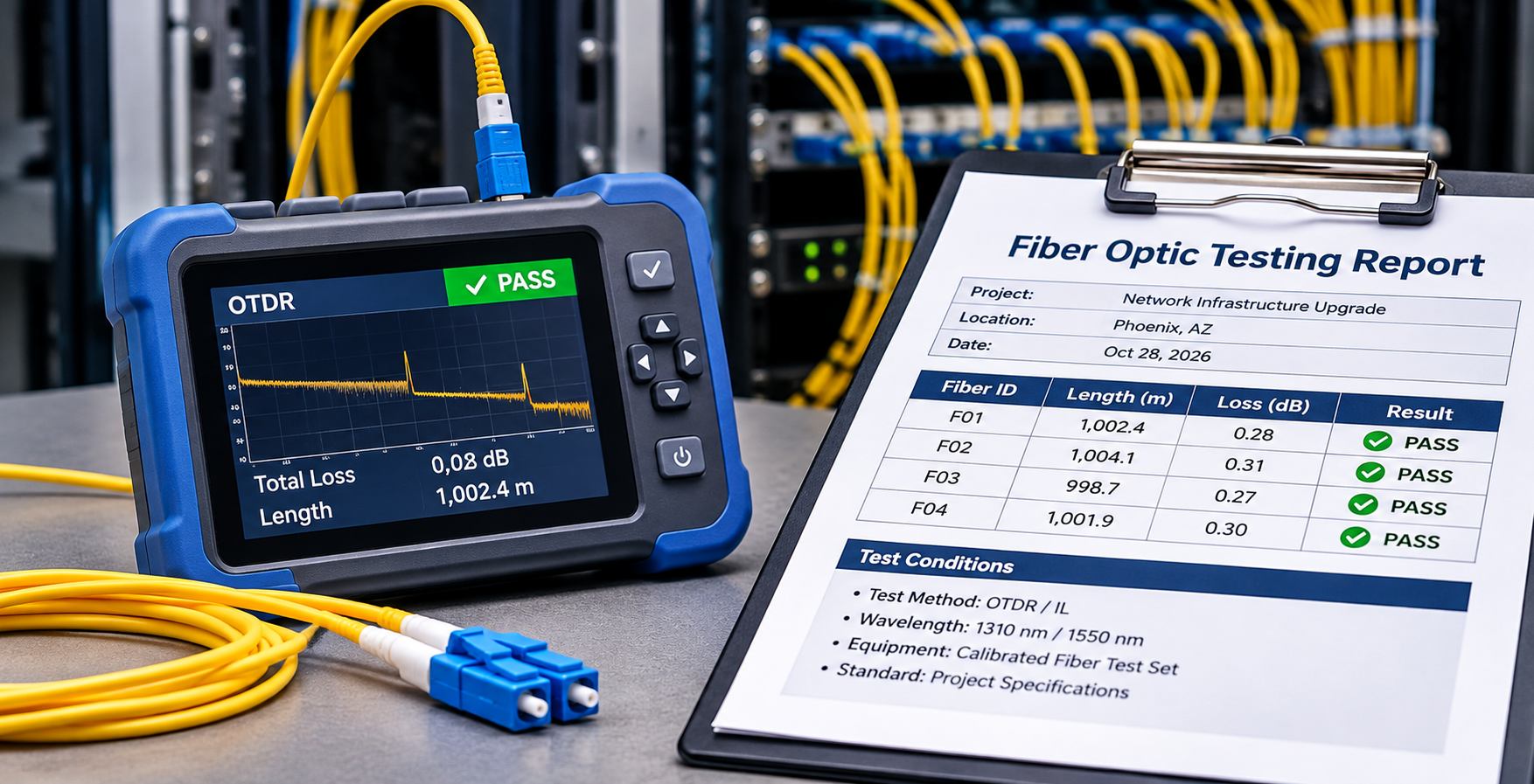
A fiber optic testing report should document whether newly installed fiber connections meet the agreed performance requirements, including measured optical loss, cable identification, test conditions, and pass-or-fail results. For commercial facilities, this documentation provides a measurable record of installation quality and a reference for future network maintenance or troubleshooting.
Completing a fiber optic installation is not simply a matter of connecting cables and confirming that network equipment powers on. The installed cabling must support the intended connections, and its performance should be verified before the project is accepted.
For commercial buildings in Phoenix, AZ, these reports can be particularly useful when multiple contractors, IT personnel, and facilities teams are involved in a construction or infrastructure upgrade.
Understanding what the report contains helps decision-makers evaluate completed work, identify outstanding concerns, and maintain accurate records of their network infrastructure.
Why Is a Fiber Optic Testing Report Important?
A fiber optic network connects equipment through optical signals transmitted along glass fibers. Although the cables may be properly installed and visually organized, appearance alone cannot confirm that every connection performs within acceptable limits.
Optical signals can experience attenuation, or signal loss, as they travel through fibers, connectors, and splices. Excessive loss can prevent equipment from communicating reliably.
Testing measures relevant characteristics of the installed cable plant and compares them against predetermined requirements.
A complete report provides several practical benefits.
First, it establishes documented measurements for the installed connections. Second, it identifies links requiring further attention before acceptance. Third, it gives facility managers and IT teams information they can reference when equipment is changed or connectivity concerns arise.
The report also creates accountability during project handover.
Instead of relying solely on verbal confirmation that the installation is complete, property managers can review recorded results and determine whether the agreed testing requirements have been satisfied.
What Information Should Be Included in the Report?
The exact format depends on the installation, applicable standards, and project specifications. However, a useful report should contain enough information to identify each tested connection, understand the testing method, and evaluate the measured results.
1. Cable and Fiber Identification
Every tested fiber should have an identifier that corresponds with the project’s labeling and documentation.
For example, a report covering a connection between a main distribution room and an intermediate distribution room should identify the relevant cable, fiber strand, and endpoints.
This information helps maintenance personnel distinguish one connection from another.
Without consistent labeling, a report may contain technically valid measurements but remain difficult to use.
In larger buildings, the ability to match test results to physical locations is especially valuable during equipment replacement or infrastructure expansion.
2. Test Date and Equipment Information
The report should identify when testing occurred and which instruments were used.
Common documentation includes the testing date, technician or operator identification, equipment details, and relevant test settings.
Recording this information allows the facility’s technical team to understand the conditions under which measurements were collected.
It also makes future comparisons more meaningful when the same connection is tested again.
3. Fiber Type and Test Wavelength
Testing must be appropriate for the installed fiber.
Single-mode and multimode installations use different optical characteristics, and measurement wavelengths should correspond with the applicable testing requirements.
Common test wavelengths include 850 and 1300 nanometers for multimode fiber and 1310 and 1550 nanometers for single-mode fiber.
Not every project requires every wavelength. The actual testing plan should follow the relevant standards, equipment requirements, and contractual specifications.
A report should clearly identify the wavelengths used so the results can be interpreted correctly.
4. Optical Loss Measurements
Optical loss is one of the most important measurements in a completed fiber installation.
It represents the reduction in optical power as light travels through the tested connection.
Loss is generally expressed in decibels (dB).
The report should show the measured insertion loss and provide the acceptance limit or calculated loss budget against which that measurement is evaluated.
A result without an appropriate reference value tells the reader relatively little about whether the connection meets its intended requirements.
5. Pass-or-Fail Results
Each tested fiber should have a clear outcome based on the applicable acceptance criteria.
A passing result indicates that the measured characteristics satisfy the specified limits for that test.
A failing result indicates that the connection requires investigation, correction, or additional evaluation.
Facility managers should be able to identify which connections passed without interpreting every technical measurement individually.
However, a passing label should always be supported by the underlying recorded results.
How Do Optical Loss Measurements Determine Whether a Link Passes?
Optical loss measurements help determine whether an installed fiber connection operates within its permitted loss budget.
The loss budget accounts for expected attenuation from the fiber itself and the connections or splices included in the optical path.
It depends on characteristics such as cable length, fiber type, connector quantity, splice count, and the applicable design requirements.
Understanding a Simple Example
Consider a hypothetical commercial fiber link with a calculated maximum permitted loss of 2.0 dB.
If testing records an insertion loss of 1.4 dB, the result falls within that example’s limit.
However, a measurement of 2.3 dB would exceed the stated maximum and require investigation.
These values are illustrative, not universal acceptance thresholds.
Actual limits must be established for the specific installation.
This distinction matters because different links can have different acceptable loss values.
A short connection inside a communication room should not automatically be evaluated using the same assumptions as a much longer backbone connection.
Why Testing Procedures Matter
The measurement is only useful when the testing method is appropriate.
For example, optical loss testing requires suitable reference cables, compatible instruments, and a correctly established measurement reference.
Dirty connectors, damaged reference cables, or incorrect test settings can affect the results.
For this reason, a report should identify the test reference method and other relevant conditions.
The Fiber Optic Association’s published testing guidance recommends maintaining records of the reference method, wavelength, measured loss, equipment, and tested fiber identification.
These details help others understand how the results were obtained.
What Is the Difference Between OLTS and OTDR Testing?
Two commonly discussed testing approaches are optical loss testing and optical time-domain reflectometer testing.
They provide different information and should not be treated as interchangeable.
Optical Loss Test Set (OLTS)
An optical loss test set uses a light source and power meter to measure the end-to-end insertion loss of a fiber connection.
This measurement evaluates the total optical loss across the tested link.
For installed cable plants, it is a primary method of determining whether insertion loss falls within the calculated budget.
The results are particularly useful during project acceptance because they provide measurable performance information.
Optical Time-Domain Reflectometer (OTDR)
An OTDR sends optical pulses into a fiber and analyzes returned light to help characterize the connection.
It can provide information about link length and the approximate location of certain events, including splices, connectors, or potential damage.
OTDR traces may help technicians investigate excessive attenuation or identify locations requiring attention.
However, an OTDR is not always necessary for every commercial installation.
Short connections can present interpretation challenges, and OTDR measurements should not automatically replace appropriate end-to-end insertion loss testing.
The selected methods should follow the approved project requirements.
Why Both May Appear in a Report
For installations where both testing methods are appropriate, the results can provide complementary information.
An optical loss test shows the measured end-to-end attenuation.
An OTDR trace may help explain where certain losses or irregularities occur along the fiber.
Together, these records can help technicians evaluate the installation and investigate unexpected results.
Organizations reviewing fiber optic systems should confirm which methods were required rather than assuming every report must include identical testing procedures.
Should Testing Reports Include Network Diagrams and Cable Records?
Ideally, testing documentation should be connected to accurate installation records.
These may include cable schedules, termination records, fiber assignments, equipment-room identifiers, and updated drawings showing installed cable routes.
A testing report alone does not necessarily describe the physical arrangement of an entire network.
For example, a result labeled only with an instrument-generated number may be difficult to interpret without corresponding cable identification.
By contrast, a report that references labeled endpoints allows an IT manager to identify the relevant connections more efficiently.
Documentation is particularly valuable when facilities undergo renovations or equipment upgrades.
A future contractor may need to determine which fiber strands are available, where they terminate, and whether existing connections can support new equipment.
Clear records reduce the need to reconstruct basic infrastructure information from the beginning.
They also provide useful context during fiber optic troubleshooting.
What Should Happen When a Fiber Fails Testing?
A failed test does not automatically mean the entire installed cable must be replaced.
The appropriate response depends on the nature and location of the problem.
Possible causes include contaminated connector end faces, incomplete connections, excessive cable bending, damaged components, or problems associated with termination or splicing.
Technicians should evaluate the results, inspect relevant components, and determine whether further testing is necessary.
After corrective work, the affected connection should be tested again using the appropriate method.
The final documentation should clearly distinguish the accepted results from earlier measurements that did not satisfy the requirements.
Why Retesting Matters
Consider a warehouse where several fiber strands connect network equipment in separate communication rooms.
If one strand records excessive optical loss, the issue should be investigated before the connection is accepted.
A technician may identify a connection-related problem, complete the appropriate correction, and repeat the measurement.
The updated result helps establish whether the connection now satisfies the acceptance criteria.
This approach provides a documented basis for approving the affected link rather than relying on an assumption that the problem has been resolved.
How Can Phoenix Businesses Review Testing Requirements Before Handover?
Commercial facilities often involve multiple parties during construction or renovation.
General contractors may coordinate installation schedules, while IT teams establish equipment requirements and facilities personnel manage long-term building operations.
For a Phoenix commercial property, the final testing requirements should be discussed before installation begins.
The agreed scope should explain which connections require testing, what methods will be used, and which records will be delivered.
For example, SharpLink Communications & Technology includes Fiber optic testing and post-installation documentation within its published fiber cabling services. Reviewing this type of service scope helps facility managers establish expectations about what will be measured and recorded.
Before approving a completed project, decision-makers should confirm several points:
- Every required fiber strand has an identifiable test record.
- The test methods and wavelengths match the agreed specifications.
- Measured results can be compared with the appropriate acceptance limits.
- Failed connections have been addressed and retested.
- Cable labels correspond with the relevant installation documentation.
- The facility has received the required electronic records.
These checks help create a more organized transition from installation to daily operation.
Can Testing Reports Help With Future Network Problems?
Yes. A properly documented report establishes an initial measurement record that can be referenced when connectivity concerns arise.
Suppose an office building experiences communication interruptions several months after installation.
The technical team may test the affected fiber and compare the new measurements with the original results.
If the measured loss has increased, that information can help guide further investigation.
However, optical loss results do not identify every possible source of a network problem.
Transceivers, switches, configuration settings, and other equipment may also affect communication.
Testing records should therefore be used as part of a broader diagnostic process.
Maintaining accessible documentation is especially useful for organizations with multiple communication rooms or frequent infrastructure changes.
Frequently Asked Questions
Does a Passing Fiber Test Guarantee Network Performance?
No. A passing fiber test confirms that the measured cable characteristics meet the specified criteria.
It does not independently verify the performance of every connected device, network application, or equipment configuration.
Should Every Fiber Strand Be Tested?
Installed fibers included in the project’s acceptance scope should be tested according to the applicable specifications.
For a complete installed cable plant, industry guidance generally calls for insertion loss testing of each fiber.
Are OTDR Traces Required for Every Project?
Not necessarily.
OTDR testing may be useful for certain backbone connections, longer cable runs, and troubleshooting situations.
Whether it is required depends on the project specifications and the suitability of the instrument and method.
Should the Facility Keep Testing Records After Installation?
Yes. Keeping the results alongside cable diagrams and other installation documents provides a useful reference for maintenance, future modifications, and investigation of connection problems.
Final Thoughts
A useful fiber optic testing report does more than indicate that an installation is complete. It explains what was tested, how measurements were obtained, and whether the results satisfy clearly defined requirements.
For commercial property managers and IT personnel, reviewing these records helps establish a reliable starting point for network operations and future infrastructure decisions.
The most valuable reports are accurate, understandable, and connected to the physical installation they describe.
About SharpLink Communications & Technology
SharpLink Communications & Technology is a BBB-accredited low-voltage contractor serving commercial facilities throughout the Greater Phoenix area, with a mailing address in Surprise, Arizona. Their services include fiber optic cabling, network infrastructure, termination, testing, and related commercial connectivity solutions. Businesses can reach their team at(602) 898-4060 or View their Google Maps business listing.