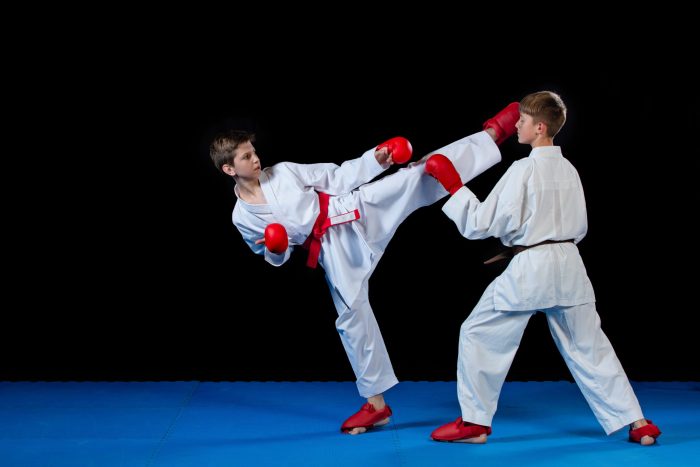
A 7-year-old who gets frustrated while learning a karate skill may simply be working through something that requires more repetition, coordination, or concentration than they expected. Parents can help by acknowledging the difficulty, encouraging effort, and allowing the instructor to guide technical corrections instead of treating frustration as a sign that the child should quit.
Learning karate involves doing unfamiliar things with the body while also listening, remembering directions, and paying attention to timing. For a young student, those demands can occasionally lead to moments such as, “I can’t do this,” “This is too hard,” or “I don’t want to try again.”
Why Do Young Karate Students Get Frustrated?
Children may become frustrated when the movement they imagine in their head does not match what their body is doing yet.
A child might understand that they are supposed to step, turn, block, or kick in a particular order but struggle to connect those parts smoothly. Another may remember a movement one day and forget part of it during the next lesson.
That gap between understanding and execution can be discouraging.
At ages 6 and 7, students are also still becoming accustomed to structured skill development. Many activities in daily life give children quick feedback or an immediate result. Martial arts can be different.
What Does Frustration Look Like in a 7-Year-Old?
Not every child expresses frustration by saying, “I’m frustrated.”
Some children become quiet.
Others start rushing through the movement.
A child may laugh, stop participating, become upset with themselves, ask to leave, or insist that they already know how to do something because admitting confusion feels uncomfortable.
Parents might also notice:
- Repeatedly saying “I can’t”
- Giving up after one or two attempts
- Becoming angry after making a mistake
- Comparing themselves with another student
- Refusing to demonstrate a difficult movement
- Asking whether they can skip the next class
- Becoming upset when corrected
- Practicing too quickly to avoid thinking about the harder parts
Recognizing these behaviors can help adults respond to the emotion underneath them instead of focusing only on the behavior itself.
Start by Acknowledging That the Skill Is Difficult
When a child is struggling, parents often want to solve the problem quickly.
They might say:
“That’s easy.”
“You already know how to do that.”
“Just try harder.”
Although these statements are usually meant to encourage, they can have the opposite effect.
If a skill feels genuinely difficult to the child, being told it is easy may make them wonder why they are struggling with something everyone else supposedly finds simple.
Help the Child Separate a Mistake From Failure
Young learners sometimes interpret mistakes very broadly.
Missing one step can quickly turn into:
“I’m bad at karate.”
Parents can help narrow the problem.
Instead of discussing the entire activity, focus on what actually happened.
“You forgot the next step.”
“That kick didn’t go where you wanted it to.”
“You lost your balance that time.”
Each statement describes a moment rather than defining the child.
This distinction matters because individual skills can be practiced. A child who believes they are simply “bad at karate” may see little reason to keep trying.
A child who understands that one movement is still difficult has a much smaller problem to solve.
Encourage Another Attempt Without Demanding Perfection
The phrase “try again” can be useful when it does not secretly mean “keep trying until you get it perfect.”
Children may need several attempts before they notice improvement.
The next attempt does not even have to be successful to matter.
A student might remember one additional step.
They may move more slowly.
They may keep their balance a little longer.
They may recognize where they became confused.
These are useful developments even when the complete movement is not correct yet.
Parents can help by noticing small changes rather than waiting only for a perfect result.
Let the Instructor Make Technical Corrections
Parents watching karate often notice mistakes.
It is understandable to want to help, especially when a child is frustrated. However, attempting to fix the technique from the sidelines or during home practice can sometimes give the child more information to sort through.
The instructor knows what the child is being taught and which details are most important at that stage.
For families looking into Martial arts for 6 year olds in Peoria, Destiny Martial Arts Academy offers its Little Dragons program specifically for children ages 6 and 7. Their age-specific structure allows instructors to work with students at a stage appropriate to younger learners.
Parents can support that process by encouraging the child to listen, practice, and ask for help while leaving specific technique instruction to the instructor.
What Should Parents Say After a Difficult Class?
The ride home can shape how a child remembers a frustrating lesson.
Immediately reviewing every mistake can turn a difficult moment into the main story of the entire class.
Instead, parents can begin with a broader question.
“What was something you liked today?”
“What felt difficult?”
“Was there anything you want to ask about next time?”
This gives children space to process both the positive and difficult parts of the lesson.
If a child focuses completely on one mistake, parents can gently put it into perspective.
“You had trouble with that one movement, but you still stayed and practiced.”
That response does not pretend the mistake did not happen. It simply prevents one difficult moment from overshadowing everything else.
Avoid Comparing a Child With Other Students
Frustration can become stronger when comparison enters the conversation.
A child may notice that another student performs a technique more easily. Parents sometimes reinforce the comparison without meaning to.
“Look how quickly that child learned it.”
“Your friend can already do this.”
These comments may be intended as motivation, but they can make a child more focused on someone else’s progress than their own learning.
A more helpful comparison is between the child today and the same child a few classes ago.
Maybe they can now remember a movement they once forgot.
What If a Child Says, “I’m Not Good at Karate”?
This is a common type of all-or-nothing thinking in young learners.
A child experiences one difficult movement and turns it into a conclusion about their overall ability.
Parents can bring the conversation back to the specific skill.
Instead of saying:
“Yes, you are good at karate.”
Telling the child they are already good at everything may not feel believable when they know they are struggling. Reminding them that learning is still happening gives them a reason to continue.
It also places attention on the process rather than a fixed label.
How Can Parents Help During Practice at Home?
Home practice should not become a punishment for having difficulty in class.
Telling a child, “You struggled today, so you need to practice for an hour,” can make the difficult skill feel even more negative.
If practice is appropriate, keep it focused.
Ask what the instructor wanted them to remember.
Let the child demonstrate what they know.
If they become unsure about the technique, avoid guessing.
A parent can simply say:
“Let’s remember that question for your instructor.”
This keeps practice connected to the class rather than creating a second set of instructions.
Break a Difficult Skill Into Smaller Pieces
Sometimes the entire movement feels overwhelming because the child is thinking about everything at once.
Parents do not need to technically break down the karate movement themselves, but they can help the child change the way they think about the challenge.
Instead of:
“I have to get this whole thing right.”
When Is It Better to Take a Break?
There is a difference between persistence and pushing through a moment when no productive learning is happening.
If a child becomes increasingly angry, tired, or unable to focus during home practice, continuing may not be useful.
Instead, it teaches them that frustration can be managed.
How Can Parents Encourage Persistence Without Pressure?
Persistence is easier to support when parents focus on actions the child can control.
A child cannot always control how quickly a skill becomes easy.
They can control whether they listen.
They can control whether they try again.
They can raise their hand or ask an instructor for clarification.
They can slow down instead of rushing.
They can return to the next class.
Those are concrete behaviors parents can recognize.
Instead of saying:
“You need to master this.”
Try:
“Keep working on one part at a time.”
That turns a large outcome into something the child can actually do.
Martial Arts Lessons for 7-Year-Olds Should Leave Room for Learning
A useful youth program should not assume young students will understand every technique immediately.
That is especially relevant when parents compare Martial Arts Lessons for 7 Year Olds with general programs that include much older students.
Age grouping can matter because younger students may need different pacing, explanations, and expectations.
Destiny Martial Arts Academy’s Little Dragons program is structured specifically for ages 6 and 7 in Peoria, separating those students from its programs for younger children and older kids.
What If Frustration Happens Every Class?
Occasional frustration is different from a child feeling distressed throughout every class.
Parents should pay attention to patterns.
Is the child frustrated only when a particular technique becomes difficult?
Do they recover after receiving help?
Do they still talk positively about other parts of class?
Or are they consistently upset before, during, and after training?
Specific frustration around a challenging skill can be part of learning.
Persistent distress may deserve a conversation with the instructor so parents can better understand what is happening during class.
Six-Year-Olds May Need Even Simpler Support
The same general principles apply to younger students.
A 6-year-old may have a harder time explaining exactly why they are frustrated. They may simply say they do not like the activity or that something is “too hard.”
Adults can ask simple, concrete questions.
“Was there one move that was difficult?”
“Did you know what to do next?”
“Did you ask for help?”
These questions are easier to answer than asking a young child to explain their emotions in detail.
Frustration Does Not Erase Progress
A child can be improving and frustrated at the same time.
In fact, frustration often appears precisely because a student cares about getting something right.
Parents can help by preventing that frustration from becoming a judgment about the child’s ability.
A difficult kick is a difficult kick.
A forgotten sequence is a forgotten sequence.
Neither one means the child has failed at martial arts.
For families considering Martial Arts Classes for 7 Year Olds in Peoria, it can be useful to look for an environment where children have opportunities to practice, make mistakes, receive instruction, and keep progressing at an appropriate pace.
The most useful response to frustration is rarely a lecture or an immediate solution.
Often, it is much simpler:
Acknowledge that something is difficult.
Encourage the child to keep learning.
Let the instructor teach.
And remind the young student that one hard skill is only one part of a much larger process.
About Destiny Martial Arts Academy
Destiny Martial Arts Academy provides martial arts instruction for children, teens, and adults in Peoria, Arizona. Their age-specific programs include Little Dragons for children ages 6 and 7, supporting young students as they develop familiarity with martial arts instruction and structured practice. Families can also Find their office on Google Maps for directions and location information.

