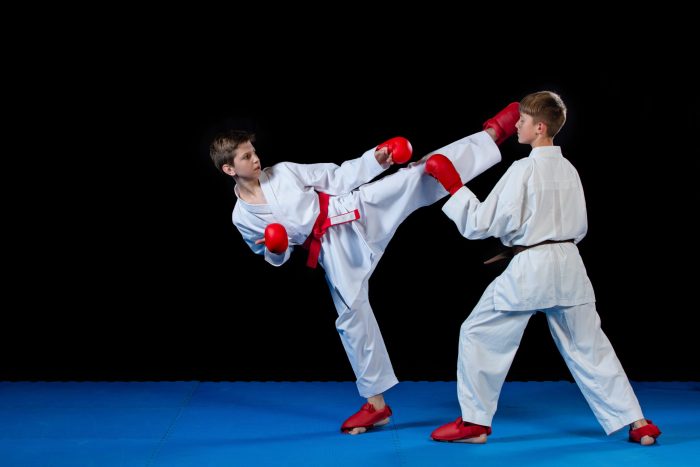
Karate techniques are practiced on both sides of the body to develop balanced coordination, dependable movement, and the ability to respond from different positions. Training the right and left sides also helps adult students identify weaknesses, improve body awareness, and avoid relying only on their dominant side.
This approach is common in structured karate for adults because real movement does not always begin from a preferred stance or direction. Students need to understand how a technique works regardless of which foot is forward or which hand performs the movement.
Why Do Most Adults Have a Dominant Side?
Most adults naturally prefer one side of the body for daily tasks. They may write, carry objects, open doors, or step forward using the same hand or leg most of the time.
That preference can also appear during martial arts training. A student may feel more stable when one foot is forward, kick more comfortably with one leg, or coordinate a strike more easily with one hand.
A dominant side is not a problem by itself. The issue occurs when a student becomes dependent on it and struggles whenever a technique must be performed from the opposite position.
Adult karate classes address this by asking students to practice movements on both sides. Over time, the less familiar side can become more organized, controlled, and dependable.
How Does Bilateral Practice Improve Coordination?
Coordination involves the brain and body working together to complete a movement in the correct order. When students first learn a stance, block, strike, or kick, they may need to think carefully about foot placement, hand position, posture, and direction.
Performing the same technique on the opposite side requires the student to process that information again. The movement cannot always be copied automatically because the body may feel different when the lead foot and working hand change.
This repeated problem-solving helps students understand the structure of the technique rather than memorizing only one version of it.
For example, a student who understands a block only with the right hand may be relying on habit. A student who can perform it with either hand is more likely to understand the starting position, movement path, stance, and finishing position.
Why Is Balance Important in Martial Arts Training?
Balanced training does not mean both sides will always feel identical. It means students work toward better control and awareness on each side.
One leg may initially feel steadier during a kick, while the other may have better flexibility. One stance may feel natural, while its opposite version requires more concentration. Practicing both sides helps reveal these differences.
Once the differences are identified, students can address them through deliberate repetition. They may slow down the weaker side, adjust their stance, review the movement path, or ask an instructor for feedback.
Martial arts classes for adults often use this process because adults may arrive with years of established movement habits. Balanced practice gives them an organized way to examine and refine those patterns.
How Does Two-Sided Training Support Footwork?
Footwork affects nearly every technique in karate. It controls distance, direction, balance, and the position from which a student blocks, strikes, or moves away.
If a student can move effectively only when one foot is forward, their options become limited. They may hesitate after changing direction or lose balance when asked to perform the same combination from the opposite stance.
Practicing footwork on both sides helps students become more comfortable stepping forward, backward, and at angles from different starting positions. It also helps them transition between techniques without always resetting to their preferred side.
In martial arts for adults, this is especially useful during forms and partner drills. Both activities may require students to change direction and perform familiar techniques from less familiar positions.
Why Are Forms Performed in Multiple Directions?
Forms are planned sequences of stances, blocks, strikes, turns, and transitions. They often require students to move in several directions while using both sides of the body.
This structure prevents students from practicing only the movements they find easiest. A form may begin with one hand and later repeat a similar sequence on the opposite side.
The repeated pattern allows students to compare their technique. They may notice that one stance is shorter, one turn is less stable, or one block finishes in a different position.
Forms also show how individual techniques connect. Instead of practicing a single movement in isolation, students learn how the body changes position before and after the technique.
Structured martial arts karate training can include this type of progressive practice, allowing adult students to develop foundational movements before applying them in longer sequences.
Does Practicing Both Sides Help With Partner Drills?
Partner drills require students to respond to another person’s position and movement. The student may not always begin with their preferred foot forward or at the most comfortable angle.
Two-sided training makes it easier to adjust. Students become familiar with moving from either stance and performing a controlled response with either side of the body.
This does not mean the right and left sides must become equally strong immediately. The goal is to reduce hesitation and help the student maintain safe, organized movement.
Control remains essential. Adult students should learn to manage distance, speed, and technique placement regardless of which side they are using.
Why Should Adults Practice the Weaker Side Slowly?
The weaker side often needs more attention rather than more speed. Moving quickly can hide errors in balance, posture, or technique path.
Slow practice allows the student to notice where the movement becomes difficult. They can check foot placement, relax unnecessary tension, and complete each part in the proper order.
Once the technique becomes more consistent, speed can be increased gradually. The student should try to preserve the same structure and control while moving at a more natural pace.
This method is useful in adult karate classes because progress depends on the quality of repetition, not simply how fast a student can complete a drill.
Will Both Sides Eventually Feel the Same?
Both sides may become more capable without feeling exactly the same. Natural differences in strength, mobility, coordination, and previous experience can remain.
The purpose of bilateral training is not to erase every difference. It is to make sure the student can move safely and effectively from more than one position.
Adults can track progress by noticing whether the weaker side requires fewer reminders, maintains better balance, and follows the correct movement path more consistently.
Improvement may be gradual, but regular practice can make unfamiliar movements feel increasingly manageable.
What Should Adults Look for in Karate Training in Peoria?
Adults exploring karate in Peoria, AZ, can look for classes that teach techniques progressively and give students opportunities to practice on both sides.
Instruction should emphasize control, posture, balance, and accurate movement before speed. Students should also receive specific feedback that helps them understand why one side feels different from the other.
Training both sides gives adults a broader and more dependable movement foundation. It supports coordination, footwork, forms, partner exercises, and the ability to perform familiar techniques from different starting positions.
Rather than treating the non-dominant side as an inconvenience, karate training uses it as an opportunity to improve awareness and technical understanding.