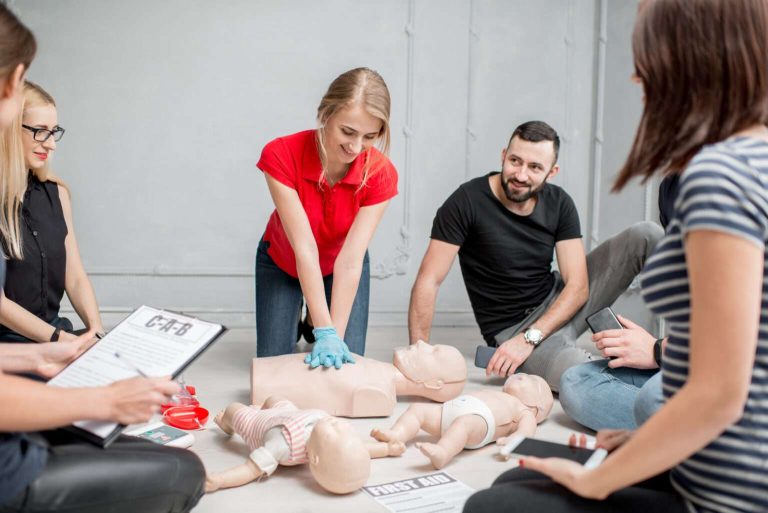
Adding First Aid to a CPR or AED course makes sense when a person may need to respond to injuries or sudden illnesses in addition to cardiac or breathing emergencies. For many workplaces, caregivers, educators, fitness professionals, and community members, combining these skills can provide broader emergency-preparedness coverage than CPR/AED instruction alone.
The important point is that CPR, AED, and First Aid are related but not interchangeable. A person may be prepared to respond to cardiac arrest after a CPR/AED course while still needing separate instruction for bleeding, burns, allergic reactions, environmental emergencies, or other First Aid situations.
That is why the right course depends on the setting, the person’s responsibilities, and any employer or organizational requirements.
What Is the Difference Between CPR, AED, and First Aid Training?
CPR focuses on responding when someone is unresponsive and not breathing normally. The goal is to support blood flow by performing chest compressions while emergency medical services are activated.
AED training teaches participants how an automated external defibrillator fits into that response. The device analyzes the heart’s rhythm and provides prompts when a shock may be appropriate.
First Aid covers a wider range of emergencies that may not involve cardiac arrest.
Depending on the course, First Aid topics may include:
- Bleeding
- Burns
- Injuries
- Allergic reactions
- Sudden illnesses
- Environmental emergencies
- Choking
- Other common emergency situations
These differences matter because a person may encounter an injury long before they ever witness a cardiac emergency.
Someone working in a childcare setting, fitness facility, workplace, school, church, or community organization may need to know what to do when an individual is conscious and injured as well as when someone becomes unresponsive.
When Is CPR and AED Training Alone Appropriate?
There are situations in which CPR/AED instruction may be the primary requirement.
For example, an employer, organization, or licensing body may specifically require CPR and AED certification without requiring separate First Aid training. A participant who needs to satisfy that requirement should confirm the exact credential before registering.
CPR and AED instruction may also make sense for someone whose main goal is learning how to respond to a cardiac emergency.
That does not make First Aid unimportant. It simply means the course selection should match the person’s actual need rather than automatically adding credentials that are not required.
People should avoid assuming that the longest course or the course with the most topics is always the correct choice.
The better approach is to ask:
- Why am I taking this course?
- Who requires the certification?
- Which emergency situations am I expected to respond to?
- Is First Aid specifically required?
- Do I need CPR and AED skills as well?
Answering those questions first can make the registration process much clearer.
When Does Adding First Aid Make More Sense?
First Aid becomes particularly relevant when someone’s work or daily responsibilities involve situations where injuries or sudden illnesses are reasonably possible.
A combined course may make sense for people who work with children, customers, employees, athletes, students, residents, or community members.
Examples include:
Childcare and Education
Teachers, childcare providers, caregivers, and other adults responsible for children may encounter situations ranging from minor injuries to choking or more serious emergencies.
Depending on the job or organization, First Aid may be part of a certification requirement.
The important step is to confirm the specific course needed rather than assuming any CPR credential automatically covers First Aid.
Fitness and Recreation
Fitness professionals often work in active environments where participants may experience injuries, sudden illness, or cardiac emergencies.
CPR and AED preparation addresses one part of that risk. First Aid can broaden a person’s preparation for non-cardiac emergencies.
Workplace Teams
Offices, warehouses, service businesses, construction-related companies, and other workplaces may have different safety needs based on the work being performed.
Some organizations may need only CPR/AED certification for certain employees, while others may require First Aid as well.
Community and Volunteer Settings
Churches, clubs, youth groups, nonprofit organizations, and community programs may bring together people of different ages and health backgrounds.
Participants who take both CPR and First Aid training can become familiar with a broader range of emergency situations.
Does CPR Certification Automatically Include First Aid?
No. CPR certification should not be assumed to include First Aid.
The American Heart Association offers CPR/AED and First Aid as separate course options as well as combined Heartsaver First Aid CPR AED training.
That distinction is important for anyone registering because course names can sound similar.
A person seeking cpr first aid certification should verify that the selected course actually includes both areas rather than assuming the terms are interchangeable.
This is especially important when training is being completed for a job, school, licensing requirement, or another formal purpose.
If an employer asks for both CPR and First Aid, completing only a CPR/AED course may not meet that requirement.
What Does First Aid Add to CPR and AED Preparation?
First Aid broadens the types of emergencies a participant learns to recognize and address.
A CPR/AED course is centered on life-threatening cardiac and breathing emergencies. First Aid instruction addresses situations in which the person may still be conscious and breathing but needs prompt care.
Consider several practical examples.
A Coworker Cuts Their Hand
A person may be injured by equipment, tools, glass, or another sharp object.
CPR is not the response to that situation. First Aid skills are more relevant.
A Child Experiences an Allergic Reaction
The child may remain conscious but require an immediate response and emergency assistance.
Again, CPR may become necessary if the situation worsens, but First Aid knowledge is relevant earlier in the event.
Someone Collapses and Stops Breathing Normally
This is where CPR and AED skills become central.
The responder needs to recognize the emergency, call for help, begin CPR, and use an AED when available.
These examples show why CPR and First Aid complement one another rather than replace one another.
Should Workplaces Combine CPR and First Aid Classes?
For some workplaces, combining the two can be a practical approach.
The American Heart Association’s Heartsaver First Aid CPR AED course is designed for people with little or no prior healthcare background who need training for work, regulatory requirements, or general preparedness. It combines First Aid topics with CPR and AED instruction in one course structure.
However, employers should still confirm whether that specific course satisfies their requirements.
A business should not choose a combined course simply because it sounds comprehensive.
Instead, management can ask:
What does the job require?
Some employees may need both First Aid and CPR. Others may only need one.
Who will employees be assisting?
A workplace that serves families or children may have different needs from an adult-only office.
What types of incidents are reasonably possible?
The work environment matters.
Are employees already certified?
Some workers may already hold a current credential in one area and only need the other.
Does the organization require a particular course?
Always verify this before scheduling.
For people comparing first aid and cpr training options, the most useful starting point is understanding whether First Aid, CPR/AED, or both are actually required.
What Should Someone Look for in First Aid Certification?
A person seeking First Aid certification should start with the organization requesting the credential.
That may be an employer, school, childcare program, licensing agency, contract administrator, or another organization.
Important questions include:
- Is a specific provider required?
- Does the course need an in-person skills component?
- Is CPR also required?
- Does the certification need AED instruction?
- How long does the credential remain valid?
- Is renewal required before expiration?
The American Heart Association currently states that Heartsaver First Aid course completion cards are valid for two years after successful completion.
That can be helpful when planning renewals, but participants should still verify whether an employer or other organization has additional timing requirements.
Is First Aid Useful Even When It Is Not Required?
Yes, it can be.
A person does not need to be taking First Aid solely for employment.
Parents, caregivers, coaches, volunteers, teachers, fitness professionals, and community members may choose First Aid instruction because they want to feel more prepared to respond to common emergencies.
However, preparation should still be based on verified course content rather than assumptions.
First Aid training does not replace emergency medical care, and participants should understand when professional assistance is necessary.
The purpose is to help people recognize emergencies, take appropriate initial steps, and know when to activate additional help.
How Should Glendale Residents Choose Between CPR and First Aid Classes?
For someone in Glendale, Arizona, geography should be only one part of the decision.
The more important question is what type of training the person actually needs.
Before choosing among cpr and first aid classes, participants can evaluate:
- Their job or organizational requirements
- Whether the credential is for initial certification or renewal
- Whether AED skills are required
- Whether First Aid is included
- Whether child or infant content is relevant
- Whether hands-on practice is required
- Whether the selected course provides the correct completion card
Local access can make training easier to schedule, but convenience should not replace course verification.
Someone who chooses a nearby class that does not satisfy their employer’s requirement may need to repeat the process with a different course.
Can First Aid Training Help With Everyday Preparedness?
It can help people become more familiar with how to respond to common emergencies.
Many emergencies happen outside of formal workplaces.
A parent may encounter a burn at home. A volunteer may see someone become ill at an event. A coach may need to respond to an injury. A coworker may suddenly collapse.
First Aid and CPR training address different parts of those situations.
That broader perspective is one reason some people choose a combined course even when their immediate requirement is limited.
The goal is not to turn participants into healthcare providers. It is to give them structured instruction for recognizing emergencies and responding within what they have been taught.
How Can Someone Avoid Taking the Wrong Course?
The simplest approach is to verify the requirement before registering.
Participants should not rely solely on a coworker’s recommendation or assume that a previous course is still the correct one.
Certification requirements can differ between jobs, organizations, and roles.
Before registering, ask the employer or requesting organization for the exact course or credential name.
Then compare that requirement with the course description.
If something is unclear, contact the training provider before paying for the class.
This can prevent common problems such as:
- Taking CPR when both CPR and First Aid are required
- Taking First Aid when AED instruction is also required
- Choosing the wrong audience level
- Enrolling in renewal when an initial course is needed
- Selecting a course that does not provide the required completion credential
A few minutes of verification can save substantial time later.
When Should First Aid Be Added to CPR or AED Training?
First Aid should be considered when the participant needs preparation for emergencies beyond cardiac arrest or breathing problems.
For many people, that includes workplace injuries, sudden illness, burns, bleeding, allergic reactions, or environmental emergencies.
The decision is especially relevant when First Aid is required by an employer or when a person’s responsibilities routinely involve other people.
CPR and AED instruction remains essential for cardiac emergencies, while First Aid expands the range of situations a participant can learn to address.
The best course is not necessarily the one with the most content. It is the one that matches the participant’s responsibilities, certification requirements, and realistic emergency-preparedness needs.
About CPR Solutions AZ
CPR Solutions AZ is headquartered in Surprise, Arizona and provides American Heart Association CPR, AED, BLS, and First Aid courses for individuals and organizations, with training access that includes Glendale and other Arizona communities. CPR Solutions operates as an AHA Training Center and can be reached at (623) 640-3591; prospective students can also locate their Arizona office on Google Maps.