An upstairs leak rarely affects only the spot where water first appears. Water can move through flooring, wall cavities, insulation, framing, and ceiling materials before a stain, drip, bulge, or other visible sign alerts the homeowner to the problem.
For homeowners in Surprise, Arizona, understanding how water moves through a house can make it easier to recognize when a small-looking leak may require more than surface-level cleanup. Prompt assessment matters because the visible ceiling damage may represent only one part of the affected area.
How Does Water From an Upstairs Leak Reach the Ceiling Below?
Water follows available pathways rather than remaining directly beneath its source.
Imagine a supply line under an upstairs bathroom sink begins leaking. Some water may remain inside the vanity, but some can travel across the floor or seep through openings around plumbing penetrations. From there, it can reach the subfloor, floor framing, insulation, wall cavities, or the drywall ceiling of the room below.
The place where water eventually becomes visible may therefore be several feet from the actual leak.
Gravity encourages water to move downward, but building materials and construction details can also redirect it horizontally. Framing, pipes, electrical openings, seams, and other components can influence the route moisture takes.
That is why finding a ceiling stain does not necessarily identify the exact location of the plumbing problem upstairs.
What Are the First Signs of an Upstairs Water Leak?
Some leaks create obvious dripping. Others develop slowly enough that the first clues are subtle.
Common signs can include:
- Yellow, brown, or discolored ceiling stains
- Bubbling or peeling paint
- Soft or swollen drywall
- Sagging areas of a ceiling
- Damp flooring upstairs
- Water appearing around ceiling fixtures
- Changes around baseboards or wall surfaces
- Persistent musty odors after a leak
- Dripping that appears some distance from the suspected source
A stain that stops growing is not necessarily proof that the surrounding materials are dry. Moisture may remain behind painted surfaces or inside enclosed building assemblies.
For that reason, homeowners should focus on both stopping the source and understanding where the water traveled.
Why Can the Visible Ceiling Spot Be Smaller Than the Actual Affected Area?
Ceiling paint can hide moisture until enough water accumulates to discolor or deform the surface.
Meanwhile, water may have spread across the back of the drywall, entered insulation, reached framing, or moved toward nearby walls. A single stain may therefore represent the point where moisture became visible rather than the full boundary of the water loss.
This distinction is important during water damage mitigation.
A restoration assessment is intended to identify affected materials rather than simply treating the most obvious stain. Depending on the circumstances, that may involve evaluating the ceiling as well as the floor system, walls, insulation, or other materials between the leak and the visible damage.
What Should You Do When Water Starts Coming Through a Ceiling?
The first priority is stopping additional water from entering the structure when that can be done safely.
If the source is a plumbing fixture, appliance, or supply line, shutting off the appropriate water supply may help limit further damage. If the source cannot be identified or safely controlled, a qualified plumbing professional may be needed.
The area beneath a visibly wet or sagging ceiling should also be treated cautiously.
Water adds weight to ceiling materials. If drywall becomes heavily saturated, it can sag or become unstable. Federal emergency guidance also advises checking ceilings for sagging because water can become trapped above them.
Electrical concerns require additional caution. Water around light fixtures, ceiling fans, outlets, or other electrical components should never be treated as a routine cleanup problem.
Once the immediate source and safety issues are addressed, professional water extraction services and drying may be necessary depending on the amount of water and materials involved.
Does a Wet Ceiling Always Need to Be Removed?
No. The condition of the material matters.
Drywall may sometimes be dried in place when it has not visibly swollen and its seams remain intact. In other cases, material may need to be removed if it has deteriorated, cannot be adequately dried, or must be opened to access wet materials behind it.
An important distinction is also needed between drywall and suspended ceiling tiles. They are different materials and do not necessarily respond to water the same way.
The source and cleanliness of the water matter as well. Clean water from a plumbing supply presents different concerns from water containing sewage or other contamination.
For homeowners, the practical takeaway is simple: the decision should be based on the actual condition of the materials and the circumstances of the leak, not a rule that says every wet ceiling must automatically be demolished.
Why Is Drying More Than Making the Ceiling Look Normal Again?
Water restoration is not complete simply because dripping has stopped or the surface feels dry.
Building assemblies can contain multiple layers. An upstairs bathroom leak, for example, might affect flooring, underlayment, subflooring, structural components, insulation, and the ceiling below.
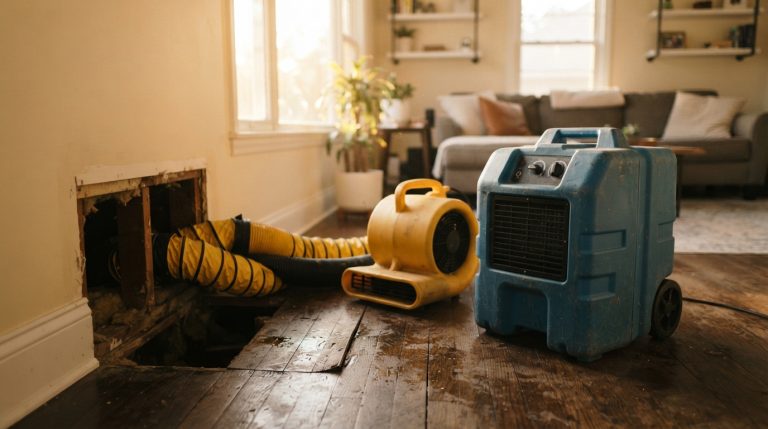
Drying strategies can involve water removal, airflow, dehumidification, and continued evaluation of affected materials. The specific approach depends on where moisture is located and what materials were exposed.
The U.S. Environmental Protection Agency recommends addressing and drying wet materials promptly and commonly uses a 24-to-48-hour window in guidance intended to help limit conditions favorable to mold growth. That guidance should not be interpreted as an automatic deadline after which every material must be discarded, but it does show why waiting several days to see whether a ceiling “dries on its own” is not a reliable strategy.
Can Water Travel Into Walls After Reaching the Ceiling?
Yes.
Once water enters the space between floors, it can encounter wall framing or openings that allow it to move into adjoining walls. A homeowner might eventually notice peeling paint, swollen baseboards, or staining in a different location from the original ceiling mark.
This is especially important when the leak occurs near a bathroom, laundry area, kitchen, or plumbing line positioned close to an interior wall.
Water can also move toward lower points in the structure. As a result, the room directly below the leak may not be the only area worth evaluating.
Professional Water damage restoration can help determine how far a loss has extended before drying and repairs are planned.
What Materials Can Be Affected Between Two Floors?
An upstairs leak can involve considerably more than drywall.
Depending on the home’s construction and the source of the leak, affected materials may include:
Flooring
Carpet, padding, tile assemblies, wood products, or other flooring materials may be exposed around the original leak.
Subflooring
Water may move through or across the subfloor before reaching the level below. Even when the finished floor looks relatively normal, materials underneath may need evaluation.
Insulation
Insulation inside floor or ceiling cavities may become wet. Different insulation materials respond differently to water, so the appropriate response depends on what is present and the type of exposure.
Framing
Wood framing can absorb moisture. Drying the surrounding cavity may therefore be part of water restoration services, even when the framing does not require replacement.
Drywall
Ceiling and wall drywall may absorb moisture, stain, swell, or lose integrity depending on the severity of exposure.
Finishes
Paint and other finishes can bubble, peel, discolor, or separate when moisture reaches the material beneath them.
Understanding the full assembly helps explain why repainting a stain before addressing remaining moisture can conceal rather than solve the problem.
What Is the Difference Between Water Mitigation and Water Damage Repair?
These stages address different parts of the problem.
Water damage mitigation is primarily concerned with controlling the immediate effects of the water loss. That can include identifying affected areas, extracting water when necessary, removing materials when appropriate, and drying the structure.
Water damage repair generally follows once the affected area has been sufficiently addressed. Repair may involve replacing removed drywall, restoring finishes, repairing flooring, or completing other reconstruction needed because of the original loss.
Separating these stages matters because repairs should not simply cover materials that remain wet.
For example, replacing a damaged section of ceiling before the cavity above has been properly evaluated and dried could conceal unresolved moisture. Effective repairs begin after the underlying water problem has been addressed.
What If the Upstairs Leak Seems Small?
The amount of visible water is not always a reliable measure of the overall problem.
A large pipe failure can produce obvious damage quickly. A slow leak may release much less water at any one moment but continue long enough for moisture to spread into surrounding materials.
Questions worth considering include:
- How long could the leak have been occurring?
- Was the source stopped immediately?
- Did water reach porous materials?
- Is there a room directly below the leak?
- Are stains continuing to grow?
- Is the ceiling soft, swollen, or sagging?
- Is water near electrical fixtures?
- Could moisture have entered an enclosed cavity?
A small puddle discovered immediately may require a very different response from a slow leak that was hidden behind a toilet, tub, vanity, or appliance.
What Should Homeowners Avoid Doing After a Ceiling Leak?
Several common reactions can make assessment more difficult.
Painting over a stain too early may hide a visible clue before the underlying area has been addressed. Assuming that dry Arizona air will resolve moisture inside a closed ceiling cavity can also be misleading.
Homeowners should also avoid cutting into visibly sagging ceilings without considering the potential for falling material, trapped water, electrical hazards, or contamination.
Using fans immediately is not appropriate in every circumstance either. If the water source may be contaminated, professional guidance is important before using equipment that could distribute contaminants.
The safest next step depends on the source, scale, and condition of the affected materials.
When Is Professional Water Restoration Worth Considering?
Professional assessment becomes especially useful when the water has moved beyond a small, immediately accessible surface.
Situations that may warrant help include water reaching the ceiling below an upstairs leak, moisture entering walls or cavities, standing water requiring extraction, affected materials that cannot be easily inspected, or damage that will require both drying and later repair.
The goal is not to remove more material than necessary. It is to understand where the water traveled, address affected materials appropriately, and avoid repairing surfaces before the underlying area is ready.
For homeowners in Surprise and surrounding West Valley communities, an upstairs leak is a good example of why water damage should be viewed as a pathway problem rather than simply a stain problem.
The Ceiling Is Often Only Part of the Story
When water from an upstairs bathroom, appliance, pipe, or fixture reaches the ceiling below, the visible mark is often the end of the water’s journey—not necessarily the beginning or the full extent of it.
A careful response involves stopping the source, considering safety hazards, identifying affected materials, removing water where necessary, drying the structure, and completing appropriate repairs only after the moisture problem has been addressed.
Understanding that sequence can help homeowners make better decisions when a leak crosses from one level of the house to another.
About Sunrise Restoration
Sunrise restoration is based in Waddell, Arizona, and provides water mitigation, emergency water extraction, restoration, and reconstruction services for properties in Surprise and other Phoenix West Valley communities. They are a licensed, bonded, and insured Arizona contractor, an IICRC Certified Firm, and an EPA Lead-Safe Certified Firm; assistance is available at 623-404-2955, and property owners can also Find their office on Google Maps.