Simply put:
• Payroll deduction POS systems let employees pay for cafeteria, gift shop, or company store purchases by having the cost withheld directly from their paycheck.
• These systems typically use employee ID badges to link point-of-sale transactions to payroll software for automated, periodic deductions.
• They are most common in hospitals, universities, and corporate campuses across the USA that operate on-site food service or retail outlets.
A payroll deduction POS system is a point-of-sale setup that allows an employee to charge a purchase, such as a meal or retail item, against their paycheck instead of paying with cash or a card at the register. The transaction is recorded at checkout and then synced with payroll processing so the amount is withheld automatically during the next pay cycle.
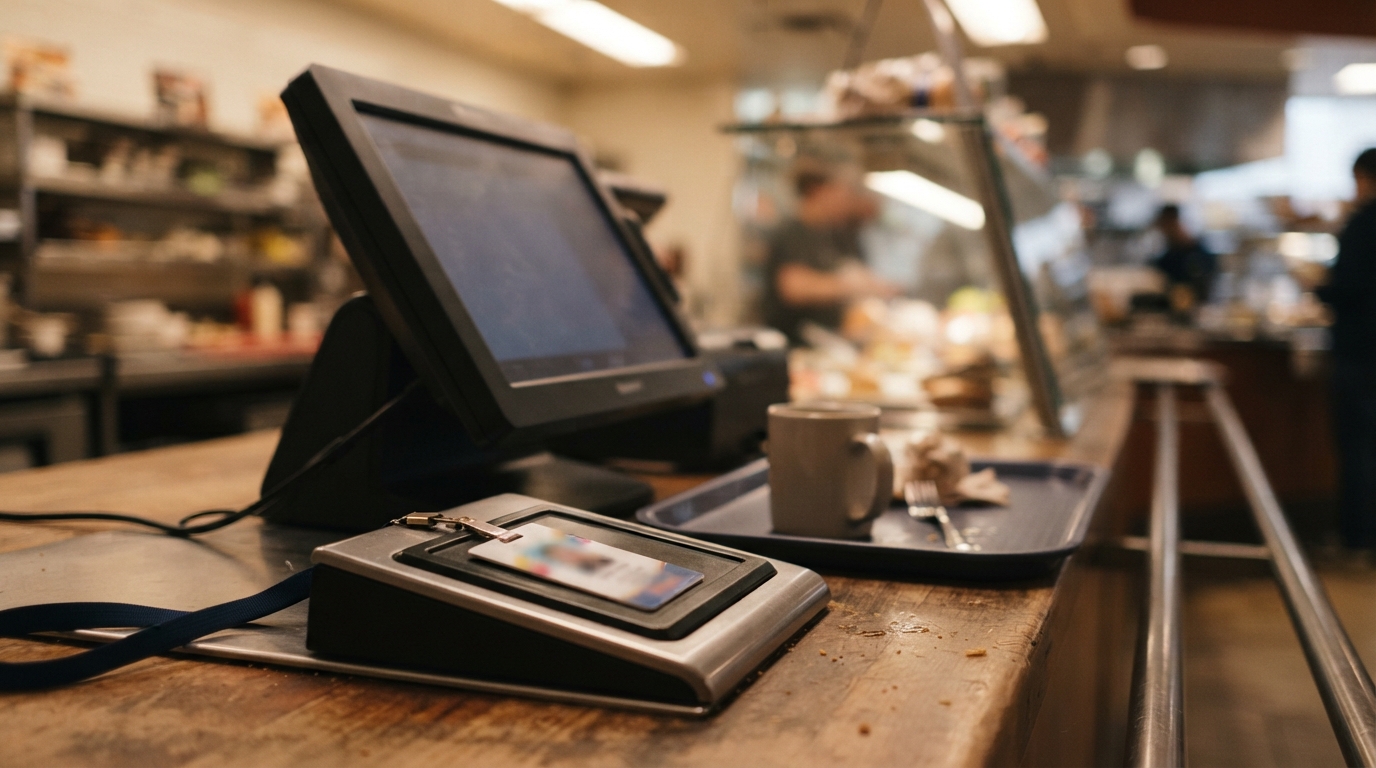
A payroll deduction POS setup generally depends on integration between the point-of-sale terminal and the organization’s payroll software, since the two systems need to exchange transaction data on a regular schedule. Employees typically scan an ID badge at checkout, and the charge is flagged for deduction rather than processed as an immediate payment. This structure is common in environments where staff make frequent small purchases, such as hospital cafeterias, corporate dining facilities, or on-site company stores. For organizations weighing this kind of system, ARBA Retail Systems offers payroll deduction POS solutions designed to connect checkout activity with payroll records, helping reduce manual reconciliation and keep employee purchase data accurate. Before choosing a provider, it helps to confirm how a system handles spending limits, deduction reporting, and compatibility with your existing payroll platform.
How the Payroll Deduction Process Works
The underlying mechanics are straightforward even though payroll compliance itself is not. At its core, the process depends on identification, data transfer, and withholding.
• Badge or ID scan : The employee scans a badge at the register instead of swiping a card.
• Transaction logging : The POS system records the purchase amount and ties it to the employee’s account.
• Payroll sync : Data transfers to the payroll platform through an API or scheduled file export.
• Withholding : The amount is deducted from the employee’s next paycheck, following the same withholding logic used for other post-tax deductions.
Payroll deductions for employee purchases are generally treated as post-tax items, meaning they are subtracted after taxes are calculated and do not reduce taxable income. This distinguishes them from pre-tax benefit deductions like retirement contributions, which follow different IRS rules and annual limits, as outlined in IRS payroll tax guidance.
Where These Systems Are Typically Used
Payroll deduction functionality tends to appear wherever an organization operates food service or retail operations for its own staff rather than the general public.
Setting |
Typical Use Case |
Badge-Based Entry |
|
Hospital cafeterias |
Staff meal purchases during shifts |
Yes |
|
Corporate campuses |
Company store or coffee bar purchases |
Yes |
|
Universities |
Faculty and staff dining |
Yes |
|
Mixed retail counters |
Serving both employees and the public at one terminal |
Optional |
Organizations across the USA that run employee-facing food service or company stores commonly adopt this model because it reduces the need for cash handling at the register while giving staff a no-interest way to pay for small, recurring purchases over a pay period.
Integration and Compliance Considerations
Payroll deduction POS systems do not operate in isolation. They need to connect with the payroll platforms an organization already uses for tax withholding, reporting, and recordkeeping.
• API or flat-file integration : Some systems exchange data continuously through an API, while others rely on scheduled file transfers.
• Accuracy checks : Because deductions affect net pay, mismatched records between the POS and payroll system can create disputes.
• Mixed-use terminals : Some point-of-sale terminals are configured to serve both the general public and employees, applying payroll deduction only to badge-based transactions from staff.
• Recordkeeping : Payroll deductions still need to be reflected accurately on wage statements and quarterly tax filings.
Organizations evaluating this type of system typically review how well it integrates with their existing payroll software before expanding it across multiple locations or departments.
Frequently Asked Questions
1. Is a payroll deduction a pre-tax or post-tax item?
→ Employee purchases deducted through a POS system are generally post-tax, meaning they are withheld after taxes are calculated and do not lower taxable income.
2. Can one POS terminal serve both employees and the public?
→ Yes. Many terminals are configured to process standard retail payments for the public while also accepting badge-based payroll deduction transactions from staff.
3. Do payroll deduction systems require special integration?
→ They typically require a connection between the point-of-sale software and the organization’s payroll platform, either through an API or a scheduled data file.
4. Are payroll deduction POS systems only used in healthcare settings?
→ No. While hospitals are a common setting, universities, corporate campuses, and other organizations with on-site food service or company stores also use this model.
Where to Find More Information
For business location and contact details, view ARBA Retail Systems on Google Business Profile. ARBA Retail Systems is a point-of-sale provider based in the USA that lists payroll deduction functionality among its product offerings.