Quick take:
- Ponding water, membrane damage, and failed flashing are the three most common flat roof problems and all three get more expensive the longer they sit.
- Standing water left for more than 48 hours after rain signals a drainage issue, not normal roof behavior.
- Interior stains, musty odors, and visible sagging usually mean a problem has already moved past the surface stage.
Flat roofs fail in predictable ways, and most issues start small: a clogged drain, a lifted seam, or a soft spot in the membrane. Catching these early typically costs far less than waiting for an active leak to reach the interior ceiling or walls.
Property owners researching Flat Roofs are usually trying to figure out whether a specific symptom, like a stain or a puddle, signals a minor fix or a bigger structural concern. The answer depends on how long the condition has existed and which part of the roof system is affected.
Ponding Water Is the Most Visible Warning Sign
Standing water on a low-slope roof is not automatically a crisis, but persistence matters. The National Roofing Contractors Association defines roof ponding as water that remains on a surface more than 48 hours after rain has stopped, and that threshold is a useful benchmark for property owners checking their own roof.
Common indicators that ponding has become a problem include:
- Dirt rings or discoloration marking where water repeatedly sits
- Visible sagging or a spongy feel underfoot in low spots
- Algae, moss, or unexpected vegetation growing on the membrane
- Water sitting in the same location after multiple separate rain events
Ponding adds significant weight to a roof deck and softens the membrane over time, which accelerates cracking and leaks in that exact location.
Membrane Damage and Seam Failures
Roofing membranes degrade from UV exposure, foot traffic, and age long before a leak appears indoors. Blisters, cracks, punctures, and lifted seams are the physical signs that a membrane is losing its ability to shed water.
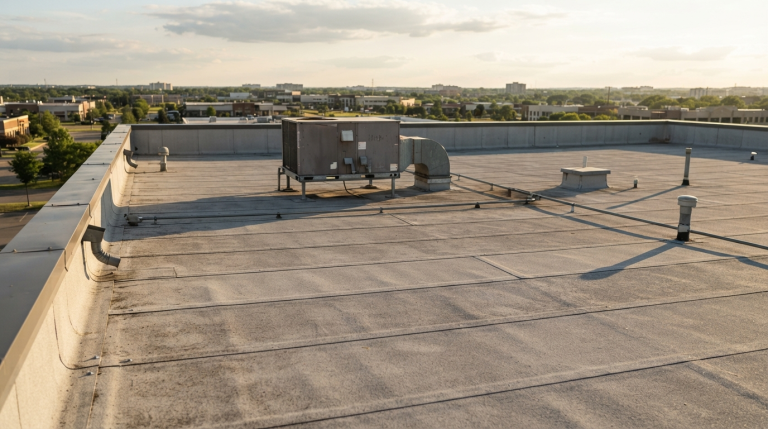
Seams and flashing around vents, drains, and rooftop equipment are frequent failure points because they are where separate roofing materials meet. A small gap at a seam or a torn flashing collar around a pipe penetration can let water travel well below the surface before any interior sign shows up.
| Problem | Typical Cause | Early Warning Sign |
|---|---|---|
| Ponding water | Poor drainage slope or clogged drains | Standing water past 48 hours |
| Membrane cracking or blistering | UV exposure, aging, foot traffic | Surface bubbles, brittle texture |
| Flashing or seam failure | Movement, weather cycling, poor installation | Lifted edges, gaps near penetrations |
| Interior staining | Any of the above left unaddressed | Ceiling spots, musty smell |
Local Climate Pressures on Flat Roofs in Newport News, VA
Coastal humidity, seasonal storms, and temperature swings common to this region put additional stress on low-slope roofing systems throughout the year. Buildings in Newport News, VA often see faster membrane aging near rooftop units and drains simply because those areas collect debris and moisture more readily during heavy rain seasons.
Routine visual checks after major storms, along with clearing debris from drains and scuppers, reduce the chance that a small drainage problem turns into a membrane failure. Scheduling a professional inspection before winter or after an unusually wet season is a practical way to catch early damage while repairs are still limited to a single section of roof.
Interior Signs That a Problem Has Progressed
Once a roof issue has reached the interior, repair complexity and cost generally increase. Watch for:
- Water stains or discoloration on ceilings or upper walls
- A persistent damp or musty smell in rooms below the roof
- Peeling paint or bubbling drywall near the roofline
- Visible drips during or shortly after rainfall
Any of these findings typically means water has already passed through the membrane and insulation layer, which usually calls for a more involved repair than a surface-level patch.
Frequently Asked Questions
How often should a flat roof be inspected? Most property managers schedule a visual inspection at least twice a year, plus additional checks after major storms, to catch ponding, debris buildup, or membrane wear before it becomes a leak.
Can a flat roof leak without any standing water present? Yes. Many leaks originate at flashing, seams, or penetrations rather than from ponding, so a dry-looking roof surface does not rule out an active leak point.
Does ponding water always mean the roof needs replacement? Not necessarily. Persistent ponding often points to a drainage or slope issue that can be corrected with tapered insulation, additional drains, or targeted leveling rather than a full roof replacement.
What is the fastest way to tell if a membrane is failing? Visible cracks, blisters, or soft spots on the surface, paired with dirt rings or discoloration in low areas, are the clearest physical signs that a membrane needs professional attention.
Flat roof problems tend to compound quietly, which is why tracking drainage patterns, membrane condition, and interior ceilings on a regular schedule remains one of the more reliable ways to limit repair scope. Based in National Roofing Corporation, the business handles flat roof work for properties across Newport News, VA.
Scheduling a Roof Evaluation
Published service area details for National Roofing Corporation are available for property owners reviewing flat roof maintenance options in the region.