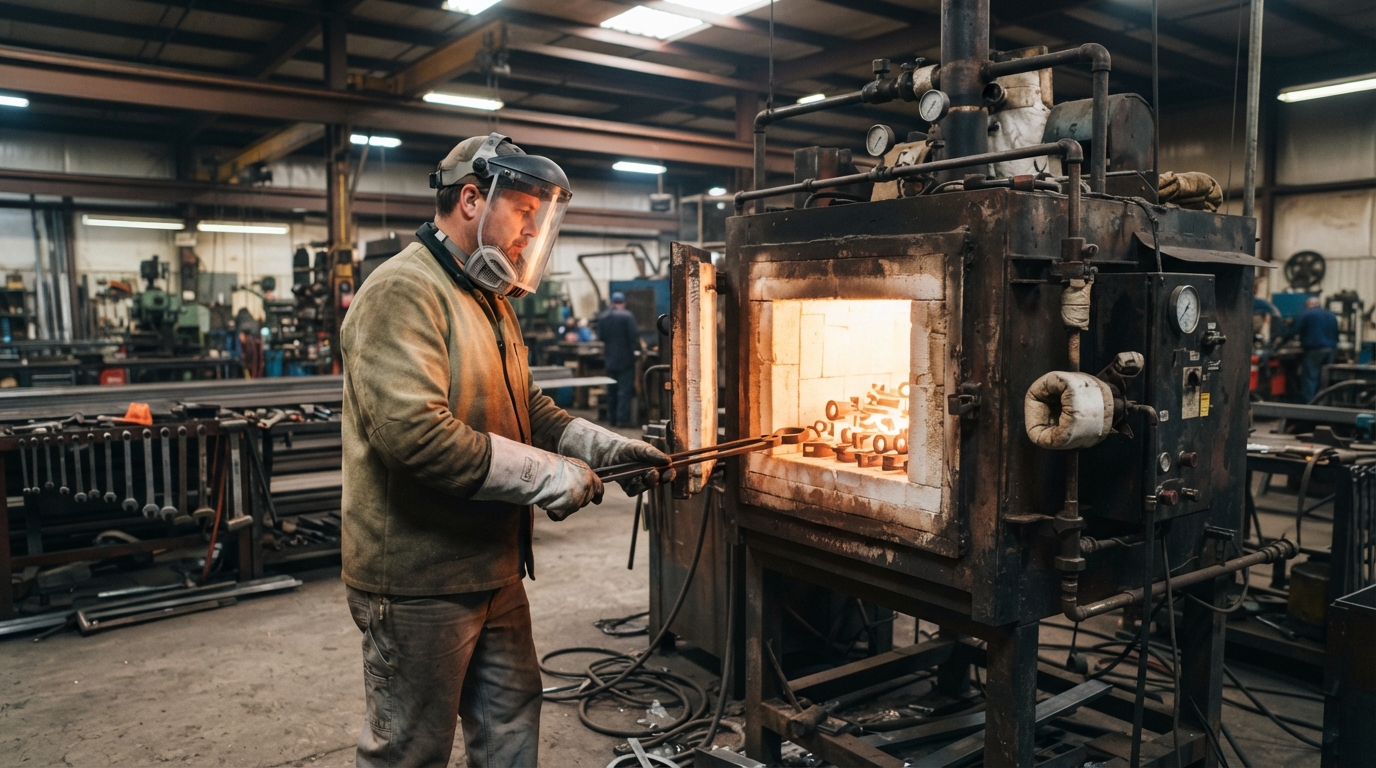
• Heat treating furnaces heat metal parts to precise temperatures to change hardness, strength, or ductility through controlled heating and cooling cycles.
• Process stages typically include heating, soaking, and controlled cooling or quenching, with target temperatures set by the specific alloy.
• Equipment design, insulation, and burner control determine how evenly and reliably a furnace holds its target temperature.
Heat treating furnaces are industrial heating chambers that raise metal parts to a specific temperature and hold them there before cooling, altering the metal’s internal structure to achieve a desired hardness, strength, or ductility. The process depends on precise temperature control rather than simple heat application, since even small deviations can change the outcome of a hardening or annealing cycle.
Manufacturers rely on Heat Treating Furnaces to prepare metal components for machining, forging, or final assembly, since raw or cast metal often needs modified mechanical properties before it can perform reliably in a finished product. The furnace itself functions as a controlled environment, and its design, insulation, and burner system determine how evenly heat distributes across a batch of parts. Equipment manufactured in Cleveland, NY and similar facilities is built around these consistent heating and holding requirements rather than general-purpose heating.
The Core Stages of a Heat Treating Cycle
Heat treating is not a single action but a sequence of controlled steps. Most processes follow a similar structure regardless of the specific alloy involved.
• Heating: The furnace raises the part to a target temperature based on the material’s composition and the intended outcome.
• Soaking: The part is held at that temperature long enough for the internal structure to reach equilibrium throughout its thickness.
• Cooling: The part cools at a controlled rate, either slowly in the furnace or rapidly through quenching in water, oil, or air.
The exact temperatures used vary widely by process and alloy. For common steels, hardening processes can require temperatures ranging from 1400°F (760°C) to as high as 2375°F (1300°C). Annealing or stress-relieving typically uses carefully controlled temperatures, often lower than for hardening, to soften the material and improve ductility without fundamentally changing its phase. Tempering, which usually follows quenching, is a heat treatment technique applied to ferrous alloys to achieve greater toughness by decreasing hardness, usually performed after quenching through controlled heating of the quenched work-piece to a temperature below its lower critical temperature.
Why Equipment Design Affects Results
A furnace’s construction has a direct bearing on whether a heat treating cycle succeeds. Several factors influence how consistently a unit performs across repeated cycles:
Factor |
Why It Matters |
|
Insulation quality |
Reduces heat loss and supports stable internal temperatures |
|
Burner control |
Allows precise ramping and holding at target temperatures |
|
Chamber design |
Affects how evenly heat reaches all parts in a load |
|
Atmosphere control |
Limits oxidation or scaling on treated surfaces |
Air circulation also plays a role in larger batch furnaces. Parts are brought to the target temperature according to the treatment requirement, and modern furnaces often include an air circulation system to ensure adequate temperature uniformity. Inconsistent heating across a chamber can leave some parts under-hardened while others become brittle from overheating, which is why furnace construction is treated as a precision engineering problem rather than a basic heating task.
Operating Safety and Process Control
Heat treating involves sustained exposure to high temperatures, open flame ignition, and quenching media that introduce their own hazards. Facilities that operate this equipment typically follow established safety practices to reduce the risk of burns, explosions, or equipment failure.
Common precautions include:
1. Wearing heat-resistant clothing, gloves, and face protection near open furnaces.
2. Confirming shut-off valves and ventilation systems are functional before ignition.
3. Avoiding direct contact between quenching oil and moisture, which can trigger violent reactions.
Standard guidance warns against standing directly in front of an oil or gas-fired furnace while lighting it and stresses that quenching oil must not be contaminated by water, since moisture contact with quenching oil can cause explosions. Facilities handling industrial furnace operations are also subject to federal workplace heat exposure considerations, since OSHA guidance on heat stress identifies furnace-adjacent work as a setting where radiant heat exposure requires engineering controls such as shielding and insulation.
Charles A Hones, Inc. is listed as a manufacturer of industrial gas burners and heat treating equipment based in Cleveland, NY.
Frequently Asked Questions
What is the difference between annealing, hardening, and tempering? Hardening raises a metal to a high temperature before rapid cooling to increase strength, while annealing uses lower, carefully controlled temperatures to soften the material and relieve internal stress. Tempering follows hardening and reduces brittleness by reheating the quenched part below its critical temperature.
Why does furnace temperature control matter so much? Metal properties shift based on exact temperature exposure, so even minor fluctuations can produce inconsistent hardness or unwanted brittleness across a batch of parts.
Are heat treating furnaces only used for steel? Steel is the most common material processed in these furnaces, but other alloys, including certain aluminum and tool steel grades, also require specific heat treating cycles tailored to their composition.
Is heat treating equipment manufactured locally in New York? Industrial furnace and oven equipment used for heat treating is manufactured by facilities located in Cleveland, NY, where production combines burner systems, insulation, and chamber design for metalworking applications.