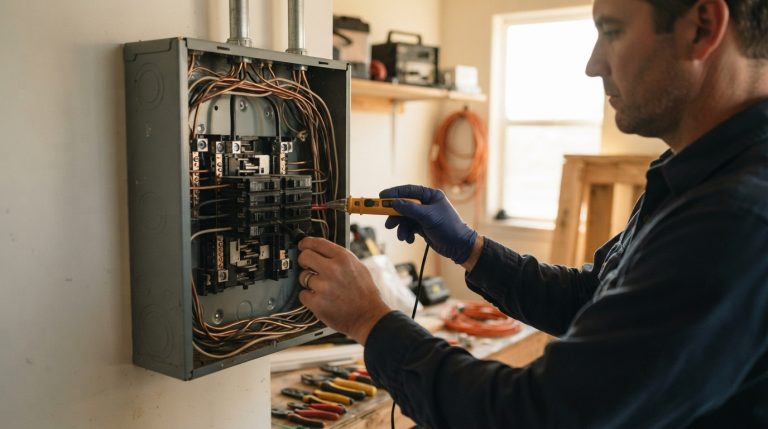
An electrical outlet can stop working even when the breaker appears to be on because the interruption may be somewhere else on the circuit. A tripped GFCI, failed receptacle, loose connection, damaged wiring, or problem at another upstream outlet can all leave one or more receptacles without power while the electrical panel looks normal.
That can make a dead outlet surprisingly confusing. A homeowner may check the breaker panel, see that every breaker appears to be in the ON position, and assume the outlet itself must have suddenly failed.
Sometimes it has. In other cases, the outlet is simply where the problem becomes noticeable rather than where the fault actually began.
Understanding how residential circuits are connected helps explain why.
Why Can an Outlet Be Dead if the Breaker Never Tripped?
A circuit breaker is only one component within a branch circuit.
After electricity leaves the electrical panel, the circuit may supply several receptacles, switches, fixtures, or other devices. Connections along that path allow power to continue from one point to another.
If something interrupts that path after the breaker, an outlet farther down the circuit can lose power without causing the breaker to move.
For example, a connection at one receptacle could become unreliable while another outlet downstream stops working completely. From the homeowner’s perspective, the dead outlet appears to be the obvious problem even though the actual fault is elsewhere.
That is why professional electrical repairs typically involve testing the circuit rather than assuming the visible symptom identifies the source.
Could the Breaker Actually Be Tripped Even Though It Looks On?
Yes.
Some breakers do not move all the way into the OFF position when they trip. Instead, the handle may rest between ON and OFF, making the change easy to miss during a quick visual inspection.
When checking the electrical panel, homeowners can look for a breaker that does not line up with the others.
However, repeatedly resetting a breaker is not a substitute for determining why it tripped. If it will not remain reset or repeatedly interrupts the same circuit, an electrical problem may be present.
The National Fire Protection Association lists frequent circuit-breaker trips among the conditions that warrant evaluation by a qualified electrician.
If the breaker is clearly on and other devices on that same circuit are operating normally, troubleshooting may need to move beyond the panel.
Could a GFCI Outlet Somewhere Else Be the Cause?
This is one of the more common explanations for an outlet that has no power while the breaker remains on.
A ground-fault circuit interrupter, or GFCI, is designed to shut off power when it detects an imbalance that could create an electrical shock hazard.
GFCI receptacles often have TEST and RESET buttons on their face. What many homeowners do not realize is that one GFCI can also protect additional receptacles connected downstream.
As a result, the outlet that has lost power may not have any buttons at all.
A tripped GFCI in another location may be controlling it.
Depending on how a home was wired, homeowners may need to look in places such as:
- Bathrooms
- Kitchens
- Garages
- Laundry areas
- Outdoor receptacle locations
- Other areas where GFCI protection is commonly installed
If an accessible GFCI has tripped, resetting it may restore power downstream.
If it repeatedly trips again, however, the next step should be finding out why rather than continuing to reset it.
The U.S. Consumer Product Safety Commission recommends testing GFCIs according to manufacturer instructions and contacting a qualified electrician if a GFCI does not operate or reset correctly.
Can One Bad Outlet Cause Another Outlet to Stop Working?
Yes, depending on how the circuit is configured.
Receptacles on a branch circuit are often connected so power continues from one electrical box to another. If a connection fails at one point in that path, devices farther downstream may stop receiving electricity.
Imagine four outlets connected along the same branch circuit.
The first two may continue working while the third develops a connection problem. The fourth could then lose power because electricity is no longer passing properly through the circuit.
The surprising part is that the third receptacle might still look completely normal from outside.
This is why replacing the visibly dead outlet does not always fix the problem.
An electrical technician may test multiple points on the circuit to determine where voltage stops rather than beginning and ending the diagnosis at the outlet that no longer works.
Could the Receptacle Itself Have Failed?
Yes.
Electrical receptacles can wear out or become damaged over time. Internal components can stop making proper contact, and repeated plugging and unplugging can contribute to wear.
A dead receptacle may also show other symptoms before it fails completely.
Homeowners might notice:
- A plug that no longer fits securely
- Intermittent operation before the outlet goes completely dead
- Visible discoloration
- Unusual warmth
- Crackling or buzzing
- Power changing when the plug is moved
A failed outlet generally needs to be replaced, but identifying a bad receptacle should still include checking the rest of the circuit when appropriate.
If the cause is actually an upstream connection or wiring issue, simply installing a new receptacle at the dead location may leave the original problem unresolved.
What Does a Loose Electrical Connection Have to Do With a Dead Outlet?
Every electrical connection along a circuit needs to remain secure.
When a connection becomes loose or deteriorates, electricity may no longer travel reliably through that point. A downstream outlet may lose power even though the breaker continues supplying electricity to the beginning of the circuit.
Loose connections also deserve attention because poor electrical connections can generate heat and may contribute to arcing.
Homeowners should not remove outlets from electrical boxes to search for loose wires unless they are qualified to perform that work safely.
A professional performing Electrical Repair can test the affected circuit, identify where normal power ends, and determine whether the issue is at the receptacle, another device, or the wiring between them.
What if Only Half of the Outlet Works?
A duplex receptacle contains two plug-in locations, and certain wiring configurations can allow the upper and lower portions to behave differently.
In some homes, one half of a receptacle may be controlled by a wall switch. This arrangement is sometimes used for lamps in rooms without a dedicated overhead fixture.
Before assuming the receptacle is damaged, check nearby wall switches.
If one half suddenly stopped working despite previously operating normally and no switch explains the change, the receptacle or its wiring may require further evaluation.
The important distinction is between an outlet that was intentionally wired for separate control and one that has unexpectedly changed behavior.
Unexpected changes are more useful warning signs than design characteristics that have always been present.
Could a Wall Switch Be Controlling the Outlet?
Yes.
Some homes have switched receptacles, where a wall switch controls all or part of an outlet. A homeowner may move into a house without realizing that a seemingly dead outlet is intentionally controlled from the wall.
Before assuming a fault exists, try nearby switches.
This is especially useful in bedrooms and living areas where switched outlets have historically been used for lamps.
However, if an outlet previously worked regardless of the switch position and suddenly stopped, the explanation is less likely to be normal switched-outlet operation.
What if Several Outlets Stop Working but the Breaker Is Still On?
When multiple receptacles lose power together, the shared circuit becomes an important clue.
Several dead outlets can point toward:
- A tripped upstream GFCI
- A failed connection at another receptacle
- A wiring problem
- A failed device supplying downstream connections
- An issue involving the branch circuit
Mapping which outlets work and which do not can help narrow down the affected section.
For example, if outlets along one wall work while several farther into a room are dead, the transition between working and nonworking devices may help an electrician locate the interruption.
That does not mean homeowners need to trace wiring themselves.
Simply noting which devices have power gives an electrical technician useful information before testing begins.
Should You Plug Something Else Into the Outlet to Test It?
Using a small device known to be working can sometimes confirm whether the receptacle is actually dead.
For instance, if a lamp works normally in another outlet but not in the affected one, that helps separate an outlet problem from a malfunctioning appliance.
However, testing should stop if the receptacle shows warning signs such as:
- Scorch marks
- Visible melting
- Excessive heat
- A burning smell
- Crackling
- Sparks
- Physical damage
NFPA advises contacting a qualified electrician for warning signs that include warm or discolored outlets, burning odors, sparks, frequent breaker trips, and flickering or dimming lights.
Those conditions call for evaluation rather than repeated testing.
Does a Dead Outlet Always Require Replacement?
No.
Replacing the receptacle only makes sense if the receptacle itself is the source of the problem.
A dead outlet caused by a tripped GFCI does not necessarily need replacement. Neither does one that has lost power because of an upstream connection.
That distinction matters because swapping components without diagnosis can turn electrical troubleshooting into guesswork.
Proper Electrician services may include checking whether power reaches the electrical box, evaluating protective devices, inspecting circuit connections, and determining whether the interruption occurs before or at the receptacle.
The appropriate repair depends on what those tests reveal.
Is It Safe to Keep Using Other Outlets in the Same Room?
That depends on what caused the failed outlet.
If one receptacle has stopped working because of an unknown electrical fault, it is difficult to determine from appearance alone whether other devices share the same problem.
Homeowners should be especially cautious when the dead outlet is accompanied by unusual heat, odors, visible damage, buzzing, flickering, or repeated electrical interruptions.
Those symptoms can indicate a condition that deserves prompt professional attention.
If the problem is limited to a straightforward tripped GFCI that resets normally and stays reset, the situation may be simpler. Repeated or unexplained failure, however, should not be treated as routine.
Could an Older Home Be More Likely to Have This Problem?
Older homes can contain electrical systems that have been modified several times over the years.
A property may have had receptacles added, rooms remodeled, circuits extended, fixtures replaced, or sections of wiring updated at different times.
That can create circuit layouts that are not obvious to the homeowner.
Scottsdale has neighborhoods representing several eras of residential construction, so two houses in the same area may have very different wiring histories.
Age alone does not prove that a home has an electrical problem. A newer property can experience a failed receptacle or loose connection too.
What matters is the condition of the actual circuit.
Why Is Troubleshooting Better Than Replacing Parts at Random?
Electrical symptoms do not always appear where the underlying problem originates.
A dead outlet could be:
- The failed component itself
- Downstream from a tripped GFCI
- Downstream from a loose connection
- Controlled by a switch
- Part of a circuit with another fault
- Affected by wiring elsewhere
Replacing components one by one may eventually appear to solve the problem, but it can also waste time and leave a hidden fault untouched.
Systematic diagnosis works differently.
A technician identifies where electricity is available, where it stops, and what component or connection separates those two points.
That process helps distinguish the symptom from the cause.
When Should a Dead Outlet Be Checked by an Electrician?
Professional evaluation becomes particularly important when:
- The breaker is on but the outlet remains dead
- Resetting a GFCI does not restore power
- Several receptacles lose power together
- Power returns and disappears unpredictably
- A breaker repeatedly trips
- An outlet feels warm
- There is visible discoloration or damage
- A buzzing or crackling sound is present
- There is an unusual burning odor
- The cause cannot be identified through simple observations
Homeowners do not need to diagnose the electrical system before requesting help.
Noting what stopped working, whether any GFCIs were tripped, whether nearby outlets still function, and when the problem began can provide valuable information.
What Is the Bottom Line?
A breaker that appears to be on does not guarantee that electricity is reaching every outlet on its circuit.
A tripped GFCI, failed receptacle, loose connection, switched outlet, upstream device, or wiring problem can all interrupt power after electricity has left the electrical panel.
That is why a dead outlet should be approached as a circuit problem first and a failed receptacle second.
For a Scottsdale homeowner, simple observations—checking the breaker position, looking for a tripped GFCI, testing whether nearby outlets work, and noting any warning signs—can help clarify what is happening without taking electrical equipment apart.
If the outlet remains dead, several devices are affected, or the problem is accompanied by heat, odor, sparking, or repeated interruptions, professional troubleshooting is the safer next step.
The objective is not merely to make the outlet work again. It is to identify why power stopped reaching it and correct the condition responsible.